
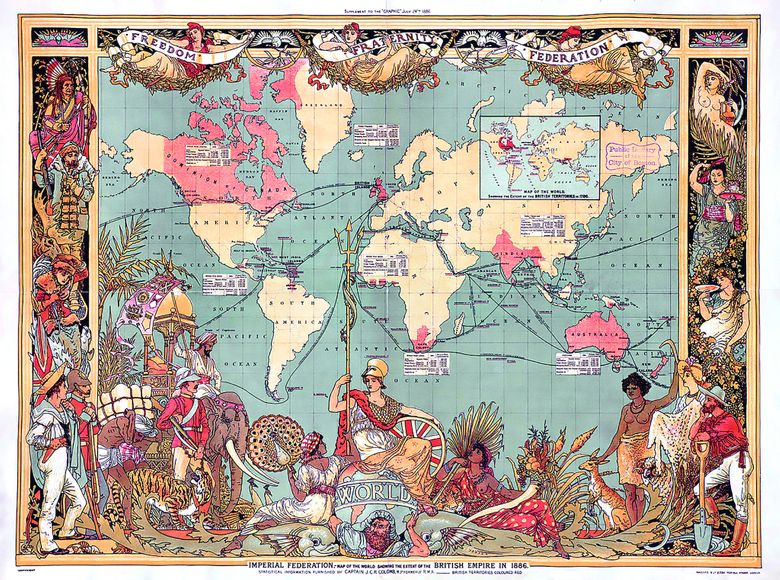
Map of British Indian Empire 1909
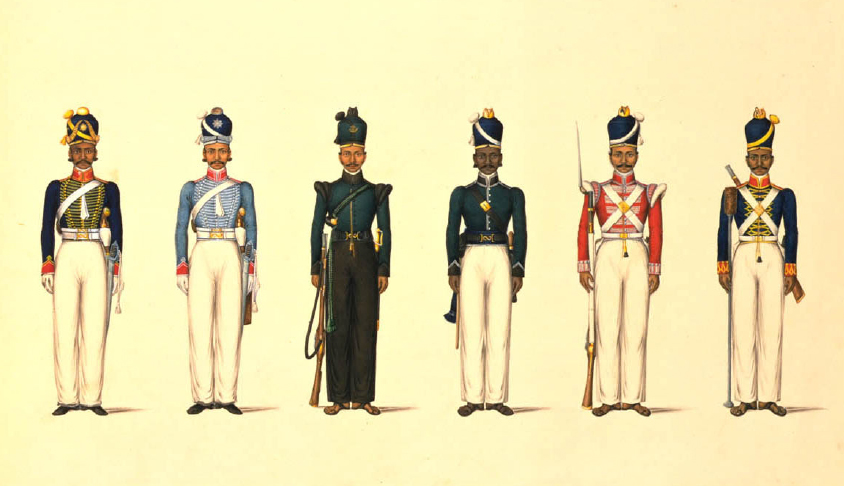
Three of Edmund Henry Seppings’s brothers emigrated to India to find employment with the Hon East India Company and the British Indian Army. The days of warring with European rivals were over. Remaining idle on half-pay with the Royal Navy wasn’t enough. Britain now ruled the waves and was busy exploiting the colonies they’d established. Edmund Henry’s brothers married, had children and grandchildren, in the British occupied Far East.
John Milligen Seppings (1805-1879) – (Quarter-Master Sergeant in the Hon East India Company and Chief Inspector of Police, Bangalore, Madras, India, in British Indian Army)
Lt Alworth Merewether Seppings (1811-1841) – British Indian Army (Bengal Artillery)
Lt William Lawless Seppings (1812-1845) – British Indian Army (Madras Native Infantry)
It is worth noting that there were four John Milligen Seppings in the family. Edmund Henry Seppings’ father was the first. Lt John Milligen Seppings, named his first-born son after himself. John Milligen Seppings (1805-1879) then named his first-born son after himself. And he named his second son after his brother: Edmund Henry Lockyer Seppings (1864-1934).
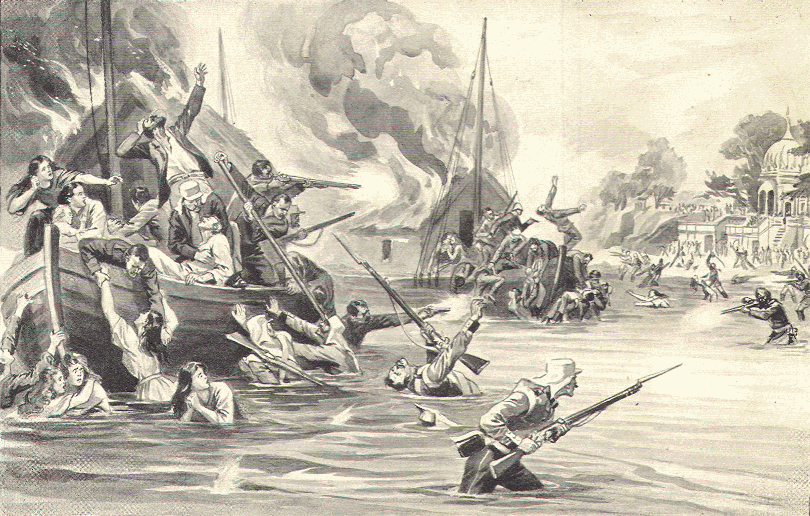
Lt John Milligen Seppings’ brother, Sir Robert Seppings, named his first-born son after him. John Milligen Seppings (1798-1863) was married in Bengal and their four children were born in Calcutta – one died as an infant. Another, Cpt Edward James Seppings (1826-1857), died in a massacre at Cawnpore with the HEIC Bengal Light Cavalry. His children were also killed in the uprising, ending Sir Robert Seppings’ male line.
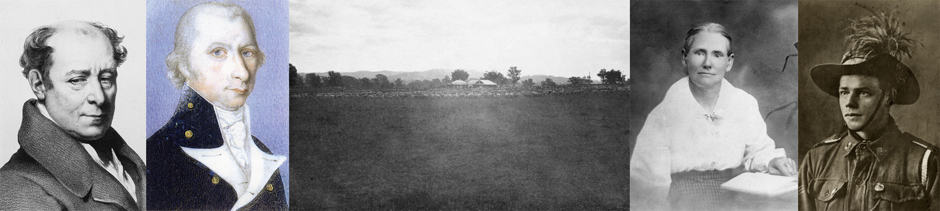
Sir Robert Seppings (1767-1840)
John Milligen Seppings (1798-1863)
Lt. John Milligen Seppings (1770-1826)
John Milligen Seppings (1805-1879); Lt Edmund Henry Seppings (1807-1858)
John Milligen Seppings (1859-1908); Edmund H L Seppings (1864-1934)
Three John Milligen Seppings lived in India; two of them died there.
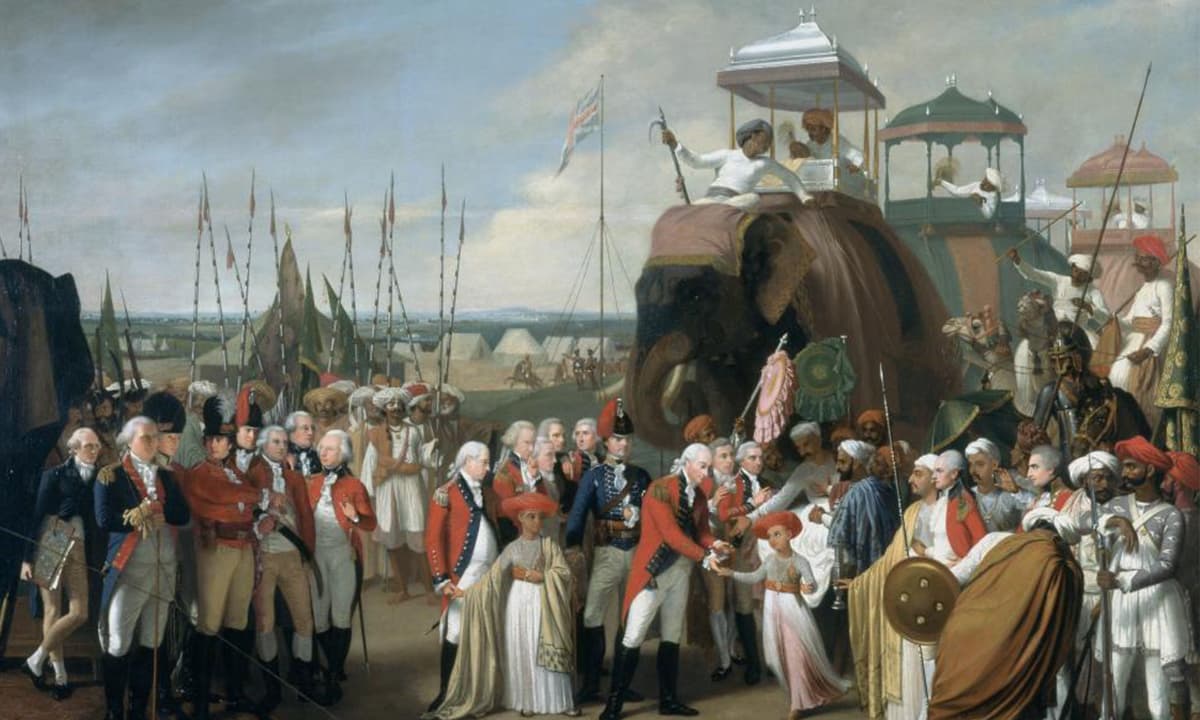
General Lord Cornwallis receiving Tipoo Sultan’s sons as hostages 1793
Bangalore – Under the Shadow of Empire
The British East India Company (EIC) established its stronghold on the Indian subcontinent from 1600. From 1757, the EIC evolved from a trading company into a military and administrative power and through its private armies acted as a de facto colonial ruler over large territories of India. From 1801 until 1858, the Madras Presidency, officially named the Presidency of Fort St. George until 1937, was ruled by the EIC and governed vast tracts of southern India, including the port city of Madras (now Chennai) and the fertile plains beyond.
From 1831, following the annexation of the Kingdom of Mysore, until 1881 when the Raja was restored to power, the British had a significant civil and military presence in the garrison town of Bangalore. Bangalore became the headquarters of British administration. Residential areas and cantonments were established, and life took on a European character with gracious bungalows shaded by jacarandas, churches, clubs, shops and theatres. It was a place where Indian and British worlds coexisted uneasily, each influencing the other, yet divided by language, custom, and law. And more importantly, by Britain’s control, resulting in India’s subservience.
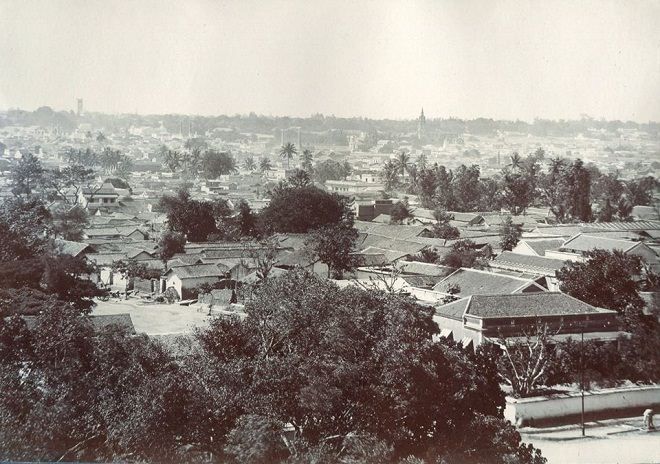
Bangalore Cantonment
For families connected to the East India Company or later the India Office, this was a time of migration from Britain for men to take up posts in distant lands, and for women to manage in unfamiliar climates. As a result of widespread resentment over the Company’s governance and the ensuing Indian Rebellion of 1857, under Queen Victoria’s 1858 proclamation, the British crown took direct control of all India, ending the East India Company Rule. Under the British Raj colonial rule (1858-1947), the region underwent significant transformation. The British occupiers reshaped local governance, landscapes, urban planning, infrastructure, and lives. Roads, railways, irrigation systems, and government buildings emerged under the direction of the Public Works Department (PWD), established in 1857. Engineers, draftsmen, clerks, and surveyors were sent from Britain or trained within the Presidency.
EIC in India – 1600–1757
Company rule in India – 1757–1858
British Raj in India – 1858–1947
British rule in Burma – 1824–1948
John Milligen Seppings (1805-1879) was in Bangalore as a Quarter-Master Sergeant in the Hon East India Company, and Chief Inspector of Police with the British Indian Army. His eldest son, John Milligen Seppings (1858-1908) was born in Bangalore, died there and is buried there. He was a Supervisor for the Department of Public Works in Madras. His younger son was born in the port city of Madras (now Chennai).
Seppings Island, located in the Bengal Presidency (now part of India and Bangladesh), is notable for its disappearance due to rising sea levels. The island, submerged, highlights the impact of climate change on coastal regions. The island’s disappearance makes evident the ongoing challenges in resolving maritime boundaries and territorial disputes in the region.

Divine Service at The King’s Palace, Mandalay, 1885
Burma: At the Edge of Empire
In 1880, Edmund Henry Lockyer Seppings (1864-1934) moved from India, where he was born, to Burma, where, in 1893, he married Ma San Mi. Their son, Henry Lockyer Seppings (b.1893/95) became an engineer who worked for the Burma Railways before transferring to the PWD. His son, Alwyn Henry Seppings (1924-2008) was the last of three generations of Seppings in Burma.
By the late 19th century, the British Empire had reached the height of its power. Following the Third Anglo-Burmese War of 1885, the Kingdom of Burma was annexed and absorbed into British India as a province. Rangoon (now Yangon) became the colonial capital, and British administrators, soldiers, traders, and their families arrived to consolidate control over this newly acquired territory.
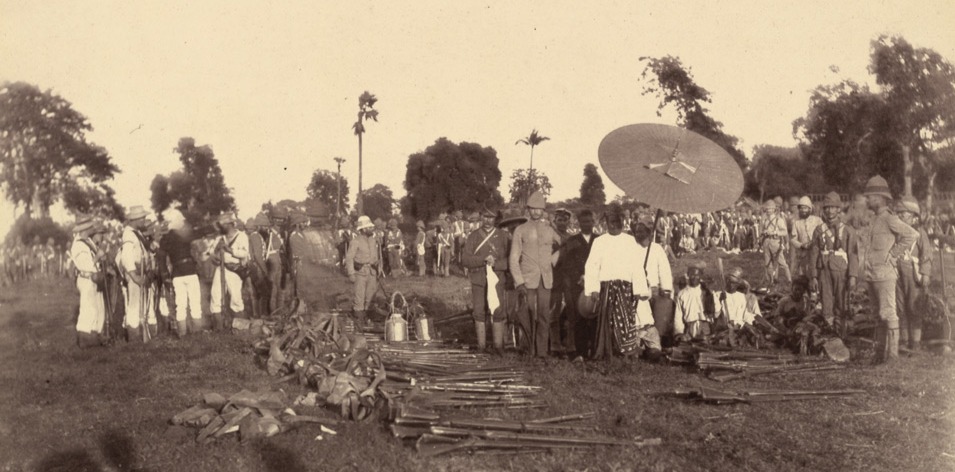
Photograph of surrender of the Burmese Army, 3rd Anglo-Burmese War 1885
Officially, the war had lasted only a couple of weeks, but resistance to British occupation continued for years, particularly in the rugged northern hills. By 1890, after deploying over 30,000 British and Indian troops to systematically destroy villages, the Empire finally subdued the liberation movement’s uprisings. The annexation transformed the country. The Burmese monarchy was abolished, traditional systems of government dismantled, and the once-unified relationship between Buddhism and the state fractured under colonial law.
For the British, Burma was a land of immense opportunity. Its vast natural resources — teak, oil, rubies, and fertile rice fields — promised wealth, and the Irrawaddy delta soon became the Empire’s rice bowl. Dense mangrove forests were cleared, canals dug, railways laid, and fleets of British-owned steamboats regularly travelled the rivers. The colonial economy of Burma attracted labourers, administrators, and specialists from across the region, particularly from India. To increase the production of rice, many Burmese migrated from the northern heartland to the delta. The British General Hospital, established in Rangoon in 1887, served the colonial community, while many families employed by the India Office, and Public Works Department, were charged with building the infrastructure of empire — roads, railways, bridges, and government buildings. They were joined by traders, customs officers, railway workers, and clerks.
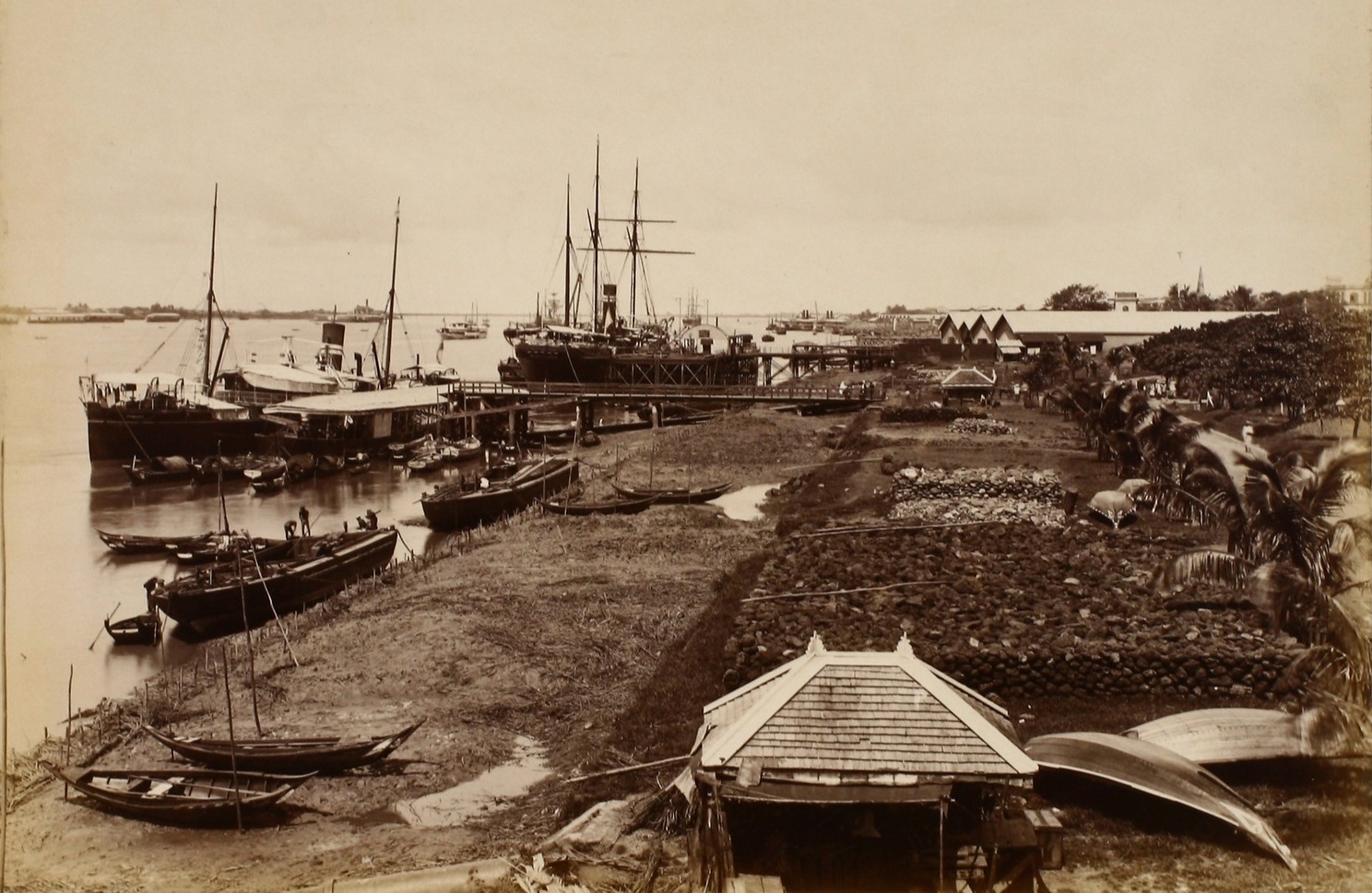
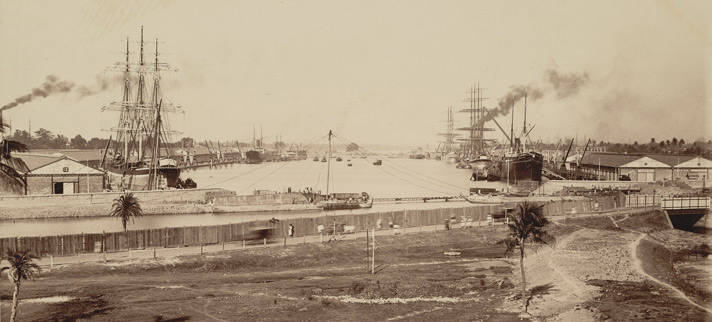
Situated on the left bank of the Hlaing River, Rangoon swelled with arrivals and transformed from a modest riverside settlement into one of British India’s greatest seaports. Rangoon became one of the most cosmopolitan cities east of the Suez Canal, with elegant colonial architecture, Anglican churches, grand administrative buildings, and lively clubs and hotels. By 1901, its population had reached 234,881, half of them immigrants from India, labourers and traders drawn by the promise of work and wealth in the colony’s booming rice, teak, and oil industries. During the peak of the rice-export season, the waterfront teemed with mills, wharves, oil depots, and warehouses, while steamships lined the docks to carry their cargoes across the Empire.
The growing Anglo-Burmese community — families of mixed European and Burmese heritage — formed an influential middle class. Most civil service posts were filled by Anglo-Burmese and Indians, while the Burmese themselves were largely excluded from administration and the military. Convent schools educated the children of British, Anglo-Burmese, and Eurasian families, instilling a European identity at the expense of their Burmese roots.
Seppings family members born or married in Burma were listed in the records as as being born or married in India, because that is where the British records were administered and kept. It is confusing to see someone born in Mandalay, Bengal, India, which geographically doesn’t exist. To be correct, it should say Mandalay, Burma. Henry Lockyer Seppings’ family were born in Rangoon, Burma, but are recorded as Rangoon, Bengal, India.*

Temple complex, Burma, 1888
In the 1930s, escalating protests and riots against Indian immigrants and the British administration, lead to the separation of Burma from India in 1937 forming a separate crown colony. Anglo-Burmans were officially recognised as an ethnic group under the Government of Burma Act. Having European blood, Anglo-Burmans were a privileged class — considered above the ethnic Burmese, but below the British. British colonial rule in Burma lasted from 1824 until independence in 1948. The majority of Anglo-Burmese chose to emigrate due to rising Burmese nationalism, and pressure to use the Burmese language.
The Seppings family lived in Shwebo, a city in Sagaing Region, Burma, 110 km north-west of Mandalay, for several years before WW2. Henry Lockyer Seppings was the superintending engineer in Shwebo. His son, Alwyn, age eighteen at the time, tells the story of the family’s escape during May 1942 in Alwyn Henry Seppings: Memoir 1932–1946. When Shwebo was bombed by the Japanese on 30 April, the family caught the last train to Myitkyina. They were among the thousands of evacuees hoping to board a plane at the airstrip which they watched being bombed. On foot, they trudged through the Kabaw Valley for several days until they reached the Chindwin River which they crossed after protracted negotiations with local fishermen who ferried them to the other side.
The Seppings family hacked its way through dense jungle in sweltering heat, uncomfortably aware that a group of Lulung tribesmen armed with spears and machetes followed them. On the Imphal–Dimapur road, a lorry took them to the Dimapur Evacuation Camp. ITA officials confirmed that some of Henry Seppings’s relatives had already crossed into India and were staying in Allahabad. The family took the train to Calcutta soon afterwards.

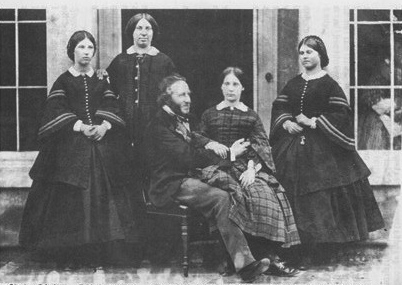
John Milligen Seppings 3rd, 2nd, and Edmund Henry Lockyer Seppings, 1880
John Milligen Seppings (1805-1879), the first born to Lt John Milligen Seppings and Ann Marshall Lockyer, was a P & D M Sergeant: a Quarter-Master Sergeant in the Hon East India Company and Chief Inspector of Police Bangalore in the British Indian Army in Madras, India. John married widow Sarah Cogswell (1814-1858) (nee Francis) on 1 Oct 1846 St. John’s Church, Secunderabad, Bmenfully, Madras, India. They had two children: Mary Margaret Seppings (b.1856) and John Milligen Seppings (1858-1908).
Sarah died at Bangalore on the 18 May 1858 aged 44 years, and John then married Margaret Ellen Johnson (1839-1906) (nee Daly) on 2 Feb 1865 in Bangalore, Madras, India. John and Margaret’s first child was a son named Edmund Henry Lockyer Seppings (1864-1934). They also had a daughter, Mary Ellen Seppings (b. 1865).
John died on 13 Dec 1879 in Mysore, India.

Mary Margaret Seppings
Seppings Nieces and Nephews
Mary Margaret Seppings (b.1856)
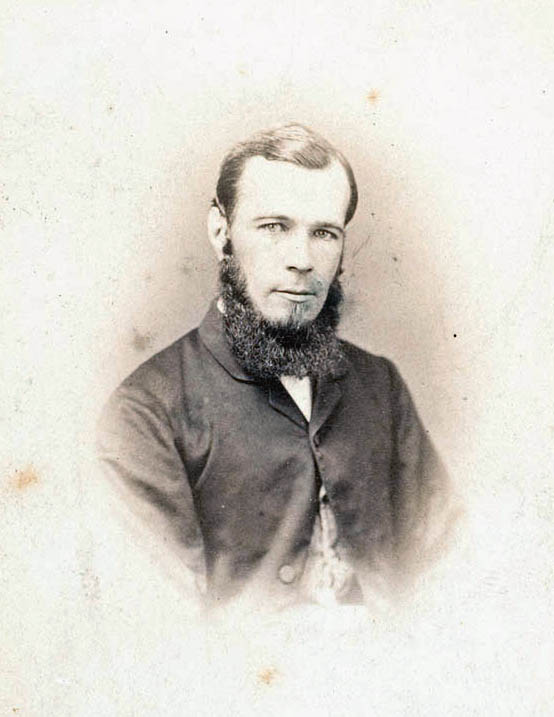
John Milligen Seppings (1858-1908), born in Bangalore, India, was the third-generation son of the same name. He was a Supervisor for the Department of Public Works in Madras. Established during the British Raj, the DPW was established in 1857. The department was responsible for constructing and maintaining infrastructure like roads, bridges, and irrigation systems. John died on 9 Dec of Pleuritis in Bangalore and was buried in Bangalore All Saints, Bangalore Holy Trinity, Madras, India.
Edmund Henry Lockyer Seppings (1864-1934), born 26 Oct 1864 in Chennai, Tamil Nadu, Madras, India, and in 1980 went to Burma in 1890 where he was Inspector General of Hospitals. On 11 Dec 1893, he married Ma San Mi (b.1856/70-1902 Burma), the daughter of P O Ein Ga, in Rangoon, Burma, and had Henry Lockyer Seppings, born 24 Dec 1893. Other children: Millicent Mamie Seppings (b.1897), Edyth Seppings (b.1900)
Mary Ellen Seppings b. 14 Dec 1865; chr. 3 Jan 1866 Madras Presidency of Fort St George, India
Seppings Grand Nieces and Nephews

Henry Lockyer Seppings (b. 1893) born 24 Dec 1893 in Kemendine, Burma, and christened on 10 December 1911, became an engineer and worked for Burma Railways before transferring to the Public Works Department (PWD). This involved irrigation works to enhance productive agriculture, improvements to wharfs at Rangoon and Moulmein, for the export of rice and timber, and the construction of canals for irrigating paddy land in Burma. Like all other public service institutions in Burma, the PWD officers were required to provide war service under the Emergency provisions during WW2. was a 2nd Lt Army in Burma Reserve of Officers. In 1942 he was the superintending engineer in Shwebo (the most senior district rank in PWD). Senior Subordinate Service officers (Sub Divisional Officers).
Henry married Edna May Blazey (b.1898 Bangalore, Bengaluru Urban, Karnataka, India) on 8 October 1917 in Mandalay, (Bengal, India*), and had five children: Nesta May Seppings (b.1918), Phyllis Maud Seppings (1919-1981), Lt Carlyle Edmund Seppings (1921-2005), Alwyn Henry Seppings (1924-2008) and Joy Mary Seppings (b. 1930).
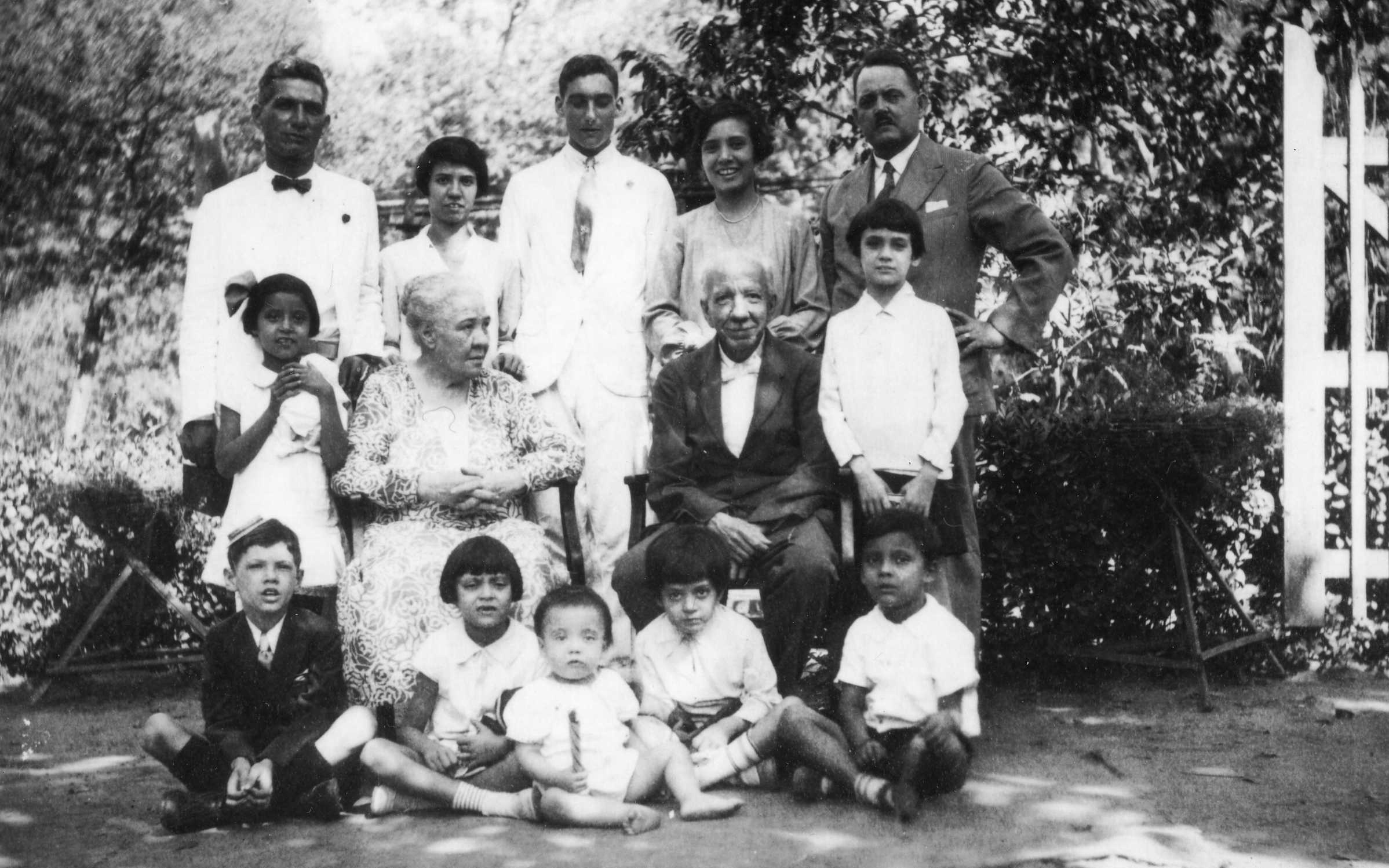
Seppings family portrait in Burma 1928
Top row L-R: Walter John Patterson, Millicent, Ron, Edith May, Geoff Cameron
Middle row L-R: adults – Mary Margaret Seppings, Edmund Henry Lockyer Seppings
Middle and Bottom row L-R: Children of Millicent and Edith May, and son of Ron
Millicent Mamie Seppings (b.1897) born on 6 Jan 1897 in Bengal, India, married Walter John Patterson (b. 1885), born on 9 January 1918, in Burma, but recorded as Bengal, India*. They had one son, Ronald Patterson.
Edyth May Seppings (b.1900) married Geoffrey Cameron (b. 1891)on 22 July 1920 in Rangoon, Bengal, India.They had at least one daughter named Edyth Cameron (b. 1922) Rangoon, Bengal, India.*
Seppings Great Grand Nieces and Nephews
Nesta May Seppings (b. 1918) born in Melkila, Holy Trinity Bengal, married Cedric West and had three children: Veronica June West (b. 1946), Jennifer Joy West and David Robert Malcolm West. (Possibly a Nicky West?)
Phyllis Maud Seppings (1919-1981) was born 2 Sep 1919 in Mamymo (Pyin Oo Lwin), Mandalay, Burma. She married a Bennett, and died in Maidstone, England.
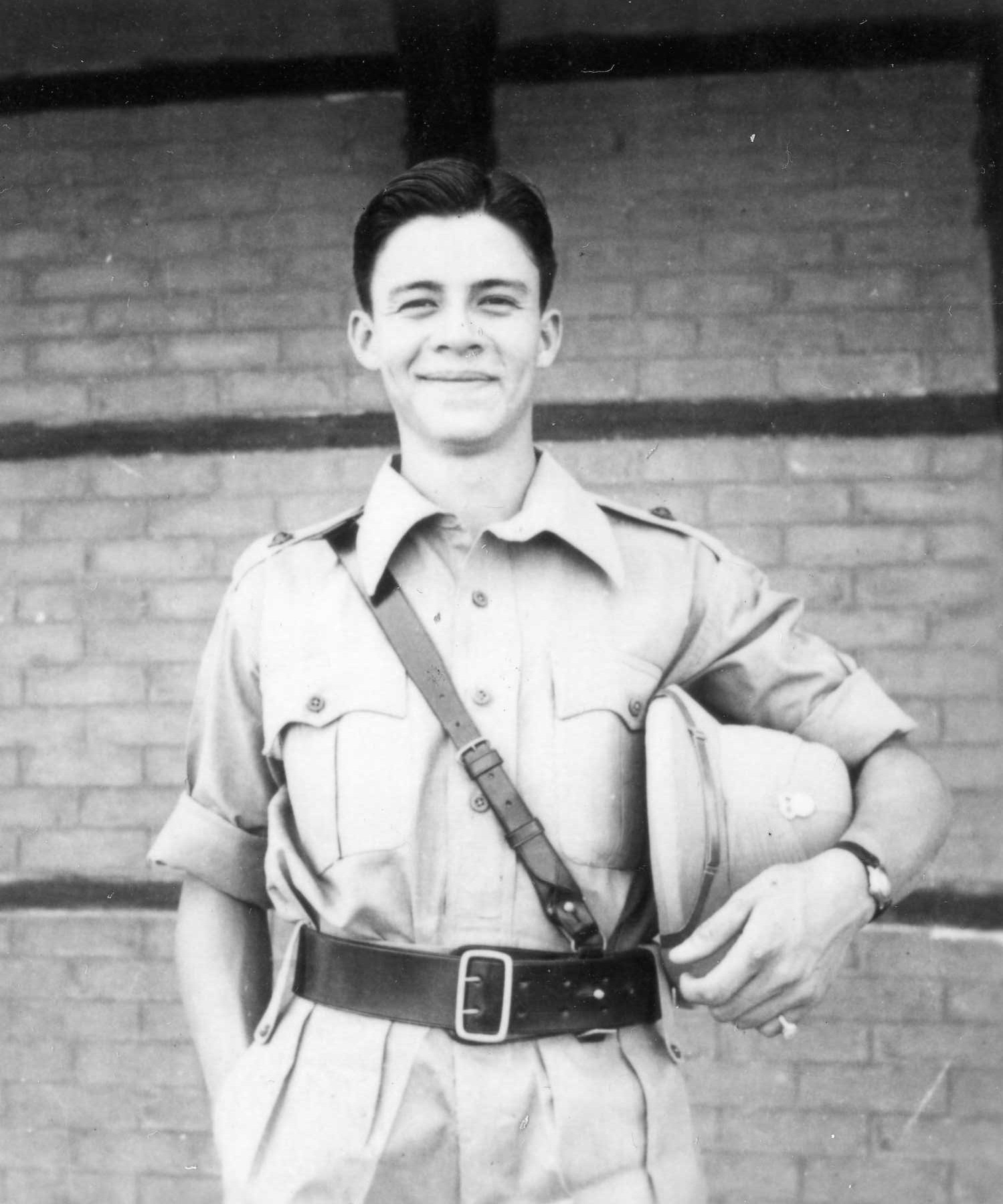
Lt/Major Carlyle Edmund Seppings (1921-2005), born 30 June 1921, Pegu, Burma. Carlyle married Pamela Beatrice Edwards (b. 1924) on 22 May 1943 in Naini Tal, Bengal, India, and had two daughters: Marilyn Joan Seppings (b. 1944) born in Calcutta, and Gillian Seppings.
In October 1941, Carlyle undertook militia training, followed by Officer Cadet training, at Maymyo, a hill town in the Mandalay Region. He was commissioned on 9 February 1942 as a 2nd Lt. in the Army in Burma Reserve of Officers (ABRO) and was posted to the 9th (Reserve) Battalion, The Burma Rifles, on 16 February, attached to the 2nd/5th Gurkha Rifles. In March he was the Liaison Officer to Chinese Military Mission, in Lashio. By April he had joined FF8, Burma Frontier Force, as column commander at Minbu. He was posted to the 3rd Battalion, The Burma Regiment, in October. Carlyle served with Special Operations Executive, ‘with the Inter-Services Liaison Department as an undercover agent in Burma’, from 1942 to 1944. After the war, he joined the Burma Police and was involved in the CID investigation of the assassination of Aung San (Rangoon, July 1947) and surveillance of the nationalist politician U Saw, 1945 to 1951. He later obtained a commission with the Royal Air Force Provost Branch, as Flying Officer (five years on the active list and four years on the reserve, from 14 August 1951, with seniority from 22 July 1950. He was appointed to a permanent commission as Flying Officer, RAF, 18 March 1953. He died in Poole, Dorset, England.
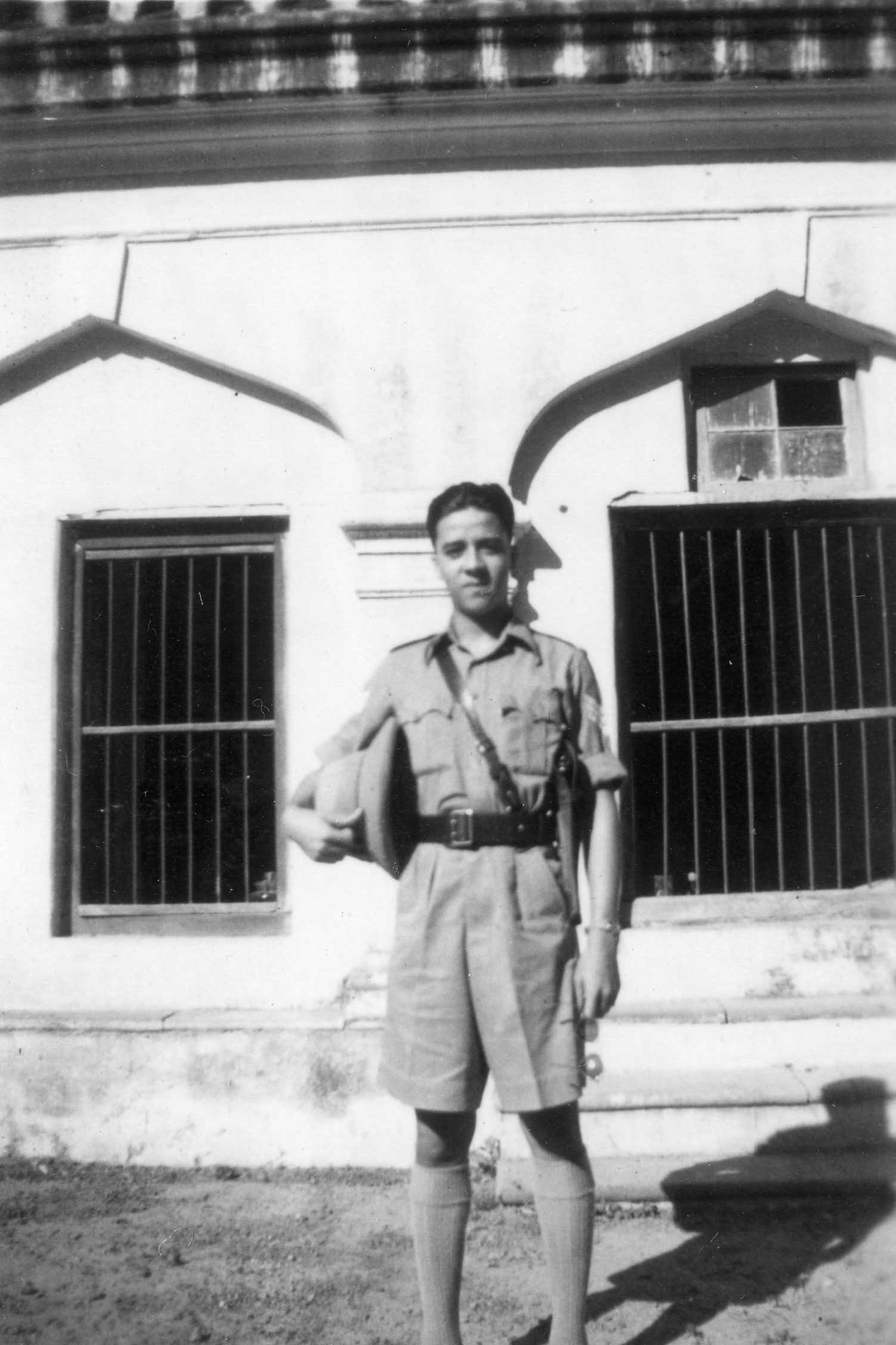
Alwyn Henry Seppings (1924-2008) born in Minbu, Birmanie, Burma, was a senior PWD engineer who married Doreen Ellen Alice Cornell (b.1928) and had two children born in London: Carlyle Cornell L Seppings (b. 1950) and Kim Angela Seppings (b.1956). Alwyn died in Eaubonne, Val-d’Oise, France.
Carlyle Cornell Seppings married Armella Bonde and had Gaelle Seppings (b.1979) and Jennifer Seppings (b.1982).
Joy Mary Seppings (b. 1930) born in Prome, Burma, married Keith J Whiting in 1952 in Essex, England.

Seppings – Cuming family
Anne Maria Swainson Seppings (1806-1863) married Rev Joseph Cuming (1796-1879) from Stourbridge, Worcestershire, at her home, Culver House, Chudliegh, Devon, in 1827. Joseph was the Master of Pynsent’s Free Grammar School, Chudliegh, 1830-43, and the curate to Rev. Gilbert Burrington. The boys studied Latin, Greek, arithmetic, algebra, geography and dictation. In the 1851 Census, his occupation was listed as ‘Keeps A School Clergyman not Having Cure of Souls’ in Hampstead. ‘Without cure of souls‘ was a phrase indicating that he was ordained but was not officiating in a parish at that time. Anne and Joseph had six children, all born in Chudleigh and christened at St Martin & St Mary, Chudleigh – Ellen Cuming (1829-1831), John Cuming (b. 1831), Henry Cuming (b. 1832), Robert Cuming (b. 1833), Emily Cuming (1837-1912), and William Cuming (b. 1841). In the 1841 Census, aside from the family, there was Anne’s mother, Anne Seppings (age 55) and sisters Eliza (age 25) and Augusta (age 20), as well as cousins Charlotte and Edward Seppings (age 15); and possibly five staff.
Cuming Nieces and Nephews
Emily Cuming (1837-1912), was a governess for William Benford Nelson esquire’s children in Putney, Surrey, in 1861, before she married Rev Henry Samuel Syers (1838-1915) from Liverpool, Lancashire, in 1866 and had three children: Mary Ellen Syers (1870-1965), John William Basil Syers (1871-1918), and Alice Gwendoline Syers (1874-1962). They lived in Paddington, London (1851), Hampstead (1861), Syston, Leicestershire (1871), St John The Baptist’s Church, Peterborough, Northamptonshire (1881, 1891), Paddington, London (1901, 1911). Their residence was Marlboro Hill Gardens.
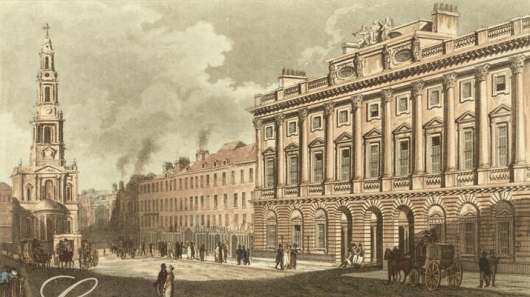
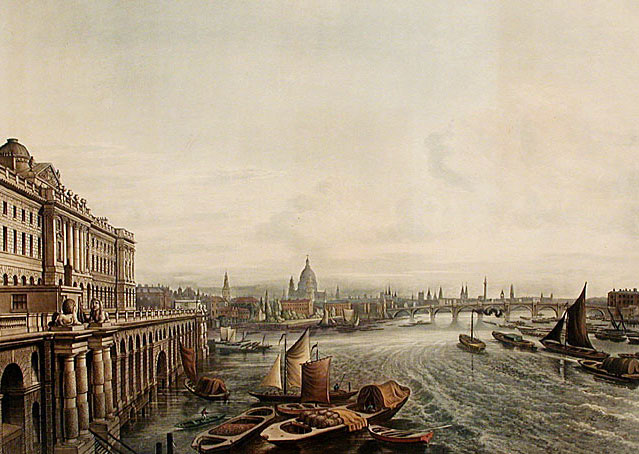
Somerset House 1809
Nicholas Lockyer Seppings (1810-1887) was a Stores and Secretary’s Office Clerk in the civil administration of the Royal Navy at the Victualling Office in Somerset Place. Nicholas married Harriet Sarah Blogg (1819-1890) in 1836 at Saint Pancras Old Church, London. According to the 1841 Census, his address is given as York Place in the Parish of St James, Clerkenwell, Middlesex. He was 30 years old and his wife, Harriett, age 20. They had two children, Rosa Anna Seppings (1836-1913) and Louisa Harriett Seppings (1838-1907), and two domestic servants.
Seppings Nieces and Nephews
Rosa Anna Seppings (1836-1913) born in Tottenham, Middlesex and christened 5 Jan 1837 St Pancras Old Church, Saint Pancras, London. 1841 and 1851 Census, she lived at Clerkenwell St James, Middlesex. Rose married Edward Barber (1831-1917) from Chigwell, Essex, in 1860 in Pancras, and they had seven children: Herbert Henry Barber (1861-1938), Horace E Barber (b. 1863), Percy S Barber (b. 1864), Frank Barber (b. 1865), Florence Barber (b. 1867) – all born in Surrey; and Ethel Barber (b. 1868) born in Teddington, Middlesex, and Cecil Barber. Rosa died 30 Aug 1913 at The Laurels, Cedar Rd, Sutton, Epsom, Surrey.
Louisa Harriett Seppings (1838-1907) born 9 March 1838, Clerkenwell, Middlesex, in 1851, was a scholar; and in 1861, she was living in Rochester Terrace, St Pancras, Middlesex. Louisa married Walter Amos Michael (1832-1903) from Saint George the Martyr, Middlesex, in March 1871, age 33, in Kensington, London, as his third wife. He was twice a widower. Walter was a company director of the Northampton & Banbury Junction Railway, and they lived in 1881 Mortlake, Surrey; in 1891 Kensington, London; in 1901 Sidmouth, Devon; and in retirement at the Hotel Continental, Ajaccio, Corsica. She died 8 April 1907 in Ashley Gardens, London. They had four children: Walter Henry Michael (1867-1957), Cyril Eden Michael (1871-1943), Reginald Warburton Michael (1874-1954), and Algernon Lionel Michael (1877-78).
Seppings Grand Nieces and Nephews
Walter Henry Michael (1867-1957) was born in London and in 1871 he resided in Sevenoaks, Kent; in 1901 his residence was in Rogate, Sussex, and by 1939 he lived in Easthampstead, Berkshire. He married Letty Maude Batchelor, born in NSW, Australia, in 1864, but was christened in Oystermouth, Glamorgan, Wales, in 1867. They were married on 19 Feb 1901 at The Mumbles, Swansea, Wales.
Cyril Eden Michael (1871-1943) born in Child’s Hill, Hendon, Middlesex, was a medical practitioner, and was married twice – once to Ada Ellen Palmer (b. 1863) from Plymouth, Devon, but no children.
Reginald Warburton Michael (1874-1954) was born in Mortlake, Surrey, and became a tenant farmer in Roxburghshire. In 1881, he resided in Margate, Kent; in 1891 – Hollesley, Suffolk; and 1901 – Lauder, Berwickshire, Scotland. He married Margaret Campbell Kerr and they had four children: Phyllis Muriel Michael (1902-02), Eric Walter Michael (1906-1953), Maurice Albert Michael (1909-1998), and Ian Lockie Michael (1915-2014).

Seppings Great Grand Nieces and Nephews
Eric Walter Michael (1906-1953) went to Ceylon at the age of 19 to learn tea planting. There he met and married Peggy Norrish in 1939. With the outbreak of WW2, Eric joined the Intelligence Corps. According to his daughter, Stephanie Warburton, ‘he was good at languages and was sent to learn Italian so as to be an interpreter for the Italian prisoners of war, first in POW camp in Ceylon, and then in Bangalore, India. He returned to Ceylon having been de-mobbed, and died two years after being superintendent of the largest rubber estate on the island. Jobs were very difficult to obtain for planters returning to Ceylon after the war as their previous jobs had been filled during their absence, so he was fortunate.’ Stephanie was born in 1940 in Ceylon, ‘but my father did not approve of girls living out East, so I was sent as a paying guest to live with my mother’s widowed sister-in-law in Scotland.’
Maurice Albert Michael (1909-1998) was a writer, literary agent and spoke five languages. He translated several books from Polish and several from Danish and German authors. Maurice Michael has 34 books on Goodreads. His most popular book is Legion of the Damned. In 1946 he married writer Pamela Kathleen Fox (1920-2011) born in in St George’s Hanover Square, London, and they had two children, Jane and Ian. Pamela Michael is the author of Edible Wild Plants & Herbs: A Compendium of Recipes and Remedies. Together they co-wrote several collections of folktales. They lived in London, then Sussex and lastly, Liskeard, Cornwall, where he died.
Ian Lockie Michael (1915-2014) born in Kelso in the Scottish Boarders, was educated in England and taught in various schools and universities in England, including University of Bristol. He was an academic: a world authority on the history and teaching of English Grammar. During WW2 he was a conscientious objector, and an ambulance driver and fire fighter. He was the first professor of education at the University of Khartoum prior to Nov 1964, when Dr Ian Michael was the first Vice-Chancellor of the University of Malawi (UNIMA) with Chancellor Prime Minister, Dr H K Banda. He retired from this service in 1973 when he became the Deputy Director of the Institute of Education and resigned in1978. He was the founding member of the Textbook Colloquium established in 1988. Michael was the author of several books on the teaching of English. In 1998, he donated his collection of Ca 680 books on Old English, English Grammar and English Literature, most of them dating from the 18th and 19th centuries, to the University College London.
In 1942, Ian married Mary E Bayley in Berkshire and they had two children, Judith and Jonathan.

Lt William Lawless Seppings (1812-1845) joined the 4th Regiment Native Infantry in Madras, India, and qualified as a cadet for the Infantry at Fort St George military garrison in 1828. Being in the Madras Army his job involved internal security and support for the civil administration. William married Isabella Georgiana Catherine White nee Lane (1814-1860) on 22 Feb 1834 in Bangalore, Madras, India. They had three children, all born in Bangalore: William John Seppings (1835-1891), Anna Maria Catherine Seppings (1836-1867) and James Edward Seppings (b. 1838).
Seppings Nieces and Nephews
William John Seppings (1835-1891) b. 26 Nov 1835 Bangalore, Madras, India; chr. 4 Jan 1836 Bangalore, Madras, India, married Sophia Louise Thomas on 27 April 1856, in Hackney, Middlesex. He died 12 Aug 1891 Pancras, London.
Anna Maria Catherine Seppings (1836-1867) born 30 Sep 1836 Bangalore, Madras, India, married John Hamilton Merritt (b.1832 Madras, India) in 1852 in Tanjore, Madras, and had eight children born in Thanjavur, Tamil Nadu: Alfred Gerald Hamilton Maxwell Merritt (b.1853), Ida Hamilton Merritt (1856-56), Ada Emily Blanche Merritt (b.1857), John Hamilton Merritt (1859-59), Edith Maude Morritt (b.1860), Edward Henry Augustus Merritt (b.1863), Emma Stella Merritt (b.1865), and Harold Sydney Merritt (b.1866). Anna died on 25 Aug 1867 Mumbai, Mumbai City, Maharashtra; buried 26 Aug 1867 at the English Cemetery in the City of Surat, Surat District, Gujarat.

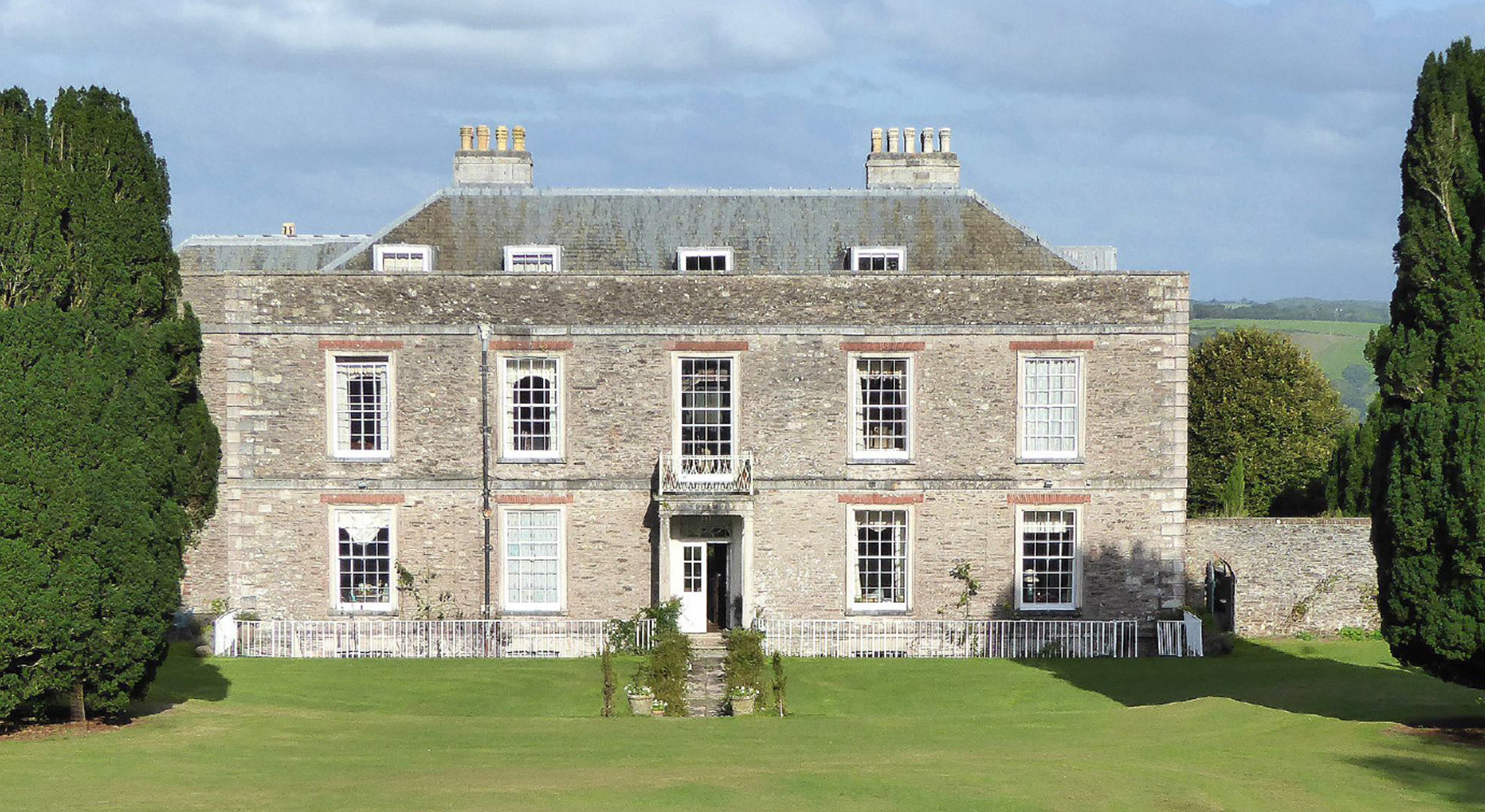
Culver House, Chudliegh, Devon
Seppings – Yarde family
Eliza Jane Bicknell Seppings (1815-1854) married landed proprietor of Culver House Thomas Yarde Esq (1796-1870), son of Surgeon and Chief Apothecary to the Poor, Thomas Yarde (1758-1833), in 1843, at St Martin & St Mary, Chudleigh, Devon. They had three sons – Rev Thomas John Yarde (1844-1908); Lt Hugh Henry Yarde (1846-1870); and Gilbert Francis Yarde (1848-1849); and one daughter, all born in Chudleigh. The Yarde family bought Culver House in 1851 and occupied it until 1909. Eliza and Thomas both died there.
Yarde Nephews
Rev Thomas John Yarde (1844-1908) lived at Culver House, Chudleigh, Devon. He married Katherine Annette Pauline Alcock (1858-93) in 1879 and they had two daughters: Amy Margaret Yarde (b. 1880) and Mary A Yarde (b. 1883).
Lt Hugh Henry Yarde (1846-1870) Gentleman Cadet from the Royal Military College, became Ensign, by purchase, and transferred to the 4th (King’s Own) Regiment of Foot on 23 Aug 1865. He would have seen action in Abyssinia in 1868. He died at sea on board SS Tangore age 23.
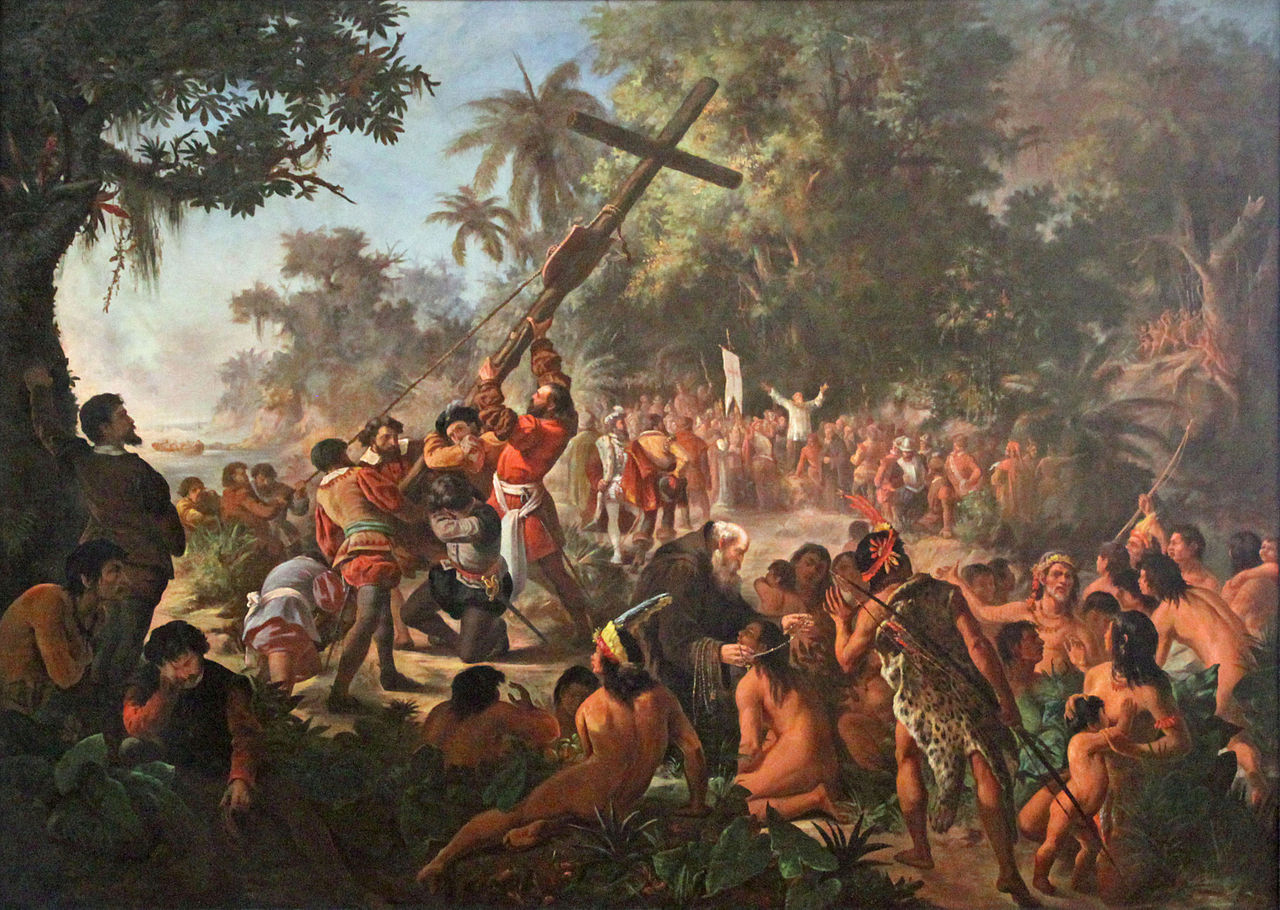
The raising of the Cross in Porto Seguro 1879
Seppings – Puttock family
Augusta Mary Seppings (1820-1910) married Rev Edward Puttock (1824-1877) from Epsom, Surrey, on 27 Sep 1855, Exeter, Devon. They spent some years in Brazil where their first three children were born – Edward, James and Frederick. They had five sons – Edward Henry Puttock (1857-1897), James Seppings Puttock (1859-1901), Frederick Lockyer Puttock (1860-1891), John Milligen Puttock (1863-1905) and Ernest Alexander Puttock (1864-1886). At age 90, Augusta outlived her husband and all her children, with Edward dying age 40, James age 41, Frederick age 30, John age 42, and Ernest age 22.
Presumably Rev Edward Puttock went to Brazil to be a missionary but there is no known record of where Rev Edward Puttock served. The Constitution of Brazil did not allow followers of non-Catholic faiths to practice their religious beliefs in public. The construction of non-Catholic places of worship was forbidden, however, these restrictions were ignored by citizens and authorities. British Protestants began settling in Brazil at the beginning of the 19th century. The first Anglican church was opened in Rio de Janeiro in 1820. Others were established afterwards in São Paulo, Pernambuco and Bahia provinces.
Puttock Nephews
Rev Edward Henry Puttock (1857-1897), born in Brazil, entered Jesus College Camridge in 1876. He married Alice Angelina Cluff (1863-1932) from Walthamstow, Essex, in West Ham, Essex, England, in 1888. He became Clerk in Holy Orders in 1891. They lived in Hallwell and Okehampton, Devon, and had five children: Edward Frederick Puttock (1889-90), John Seppings Puttock (b.1892), Dora Mary Augusta Puttock (1894-1969), Denys Ernest Puttock (1895-1919), and Mary Katherine Puttock 1898-1948). Edward was the Rector of Hallwell at St Peter & St James’ Church.
James Seppings Puttock (1860-1901) born in Brazil, was living with his uncle James H Puttock (b. 1823), a widowed publisher, in Richmond, Surrey, in 1871, and brother Edward. He married Louisa Emma Webb (1871-1915) in King Williams Town, Cape Province, South Africa, in 1891 and in 1892 it is recorded that he is a Sergeant CMR (Cape Mounted Rifles) in South Africa. They had four daughters and one son: Grace Seppings Puttock (1892-1928), Frederick Lockyer Puttock (1893-1908), Maud Louise Puttock (1894-1964), Ada Mary Puttock (1897-1989) and Sylvia Edith Puttock (1901-1954). Fred was killed age twelve. James died 30 January 1901 at Matitlle, KwaZulu-Natal, Cape Province, South Africa.
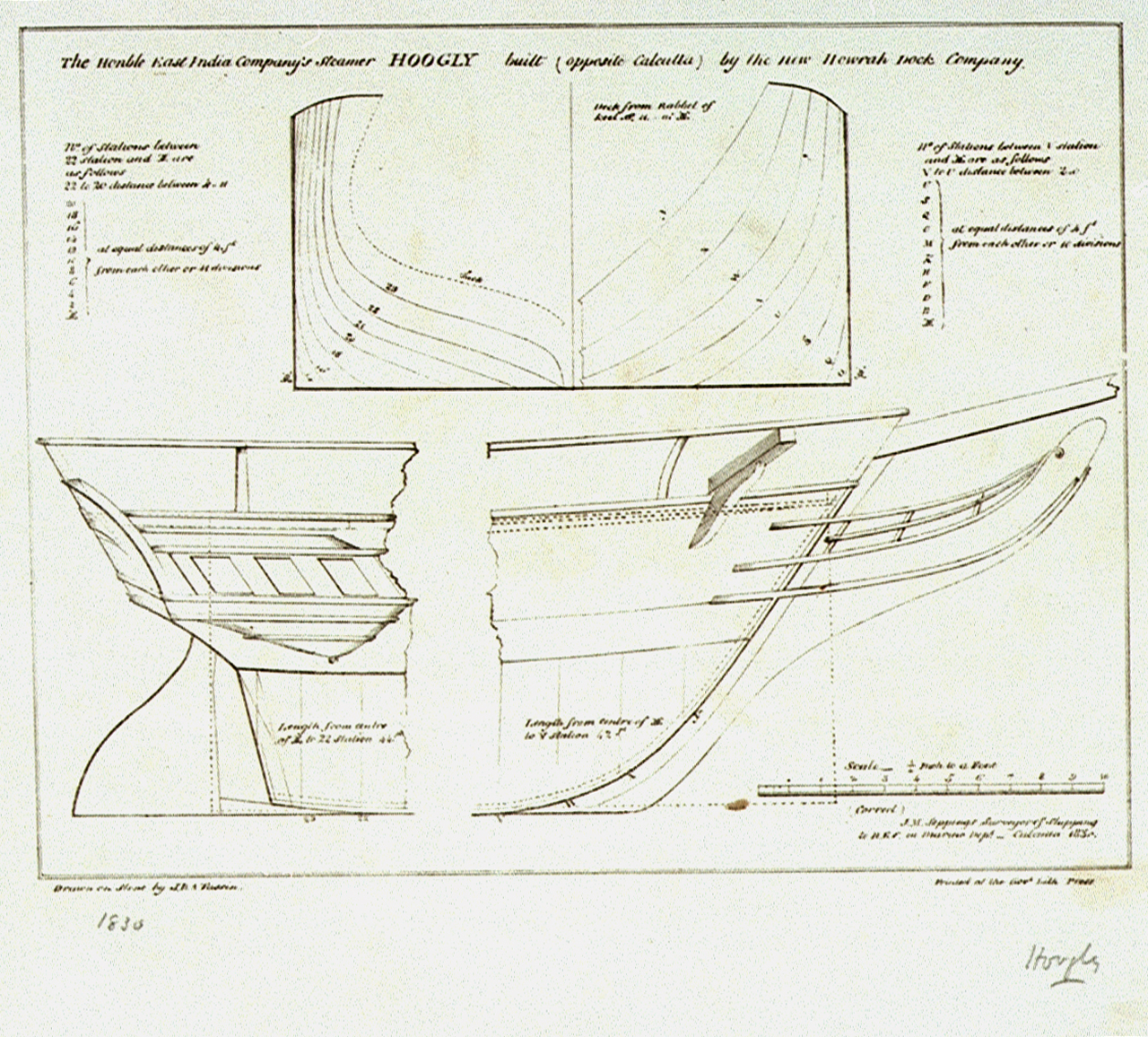
Frederick Lockyer Puttock (1861-1891) was born in Brazil. In the 1871 census, Frederick, age ten, is in Brazil as a scholar. He served in the Bengal Pilot Service (1875-77). In the 1870s, the Bengal Pilot Service was part of the Bengal Marine and guided ships traveling along the Hooghly River between Calcutta and the Bay of Bengal. In 1877, the Bengal Marine and the Bombay Marine were combined to form HM Indian Marine. Frederick drowned at about age 30 in Bengal, India.
John Milligen Puttock (1863-1905) was born in Exeter and, at age 15, was indentured as an apprentice in the Merchant Navy in Liverpool, in 1878. He married Sybil Antoinette Kent (1883-1906) on 6 Aug 1904 in Calcutta, Bengal, India. When he died at age 42 in Genova, Liguria, Italy, he was listed as of Calcutta, India.
Ernest Alexander Puttock (1864-1886) born in Exeter, Devon, and died in Hackney, London, age 22.
Puttock Grand Nieces and Nephews
Denys Ernest Puttock (1895-1919) attended Twyford School and St Edmund’s School in Canterbury, Kent. He began a career in the Royal Navy, enlisting in September 1913. He served in the Highflyer as a cadet, and was a midshipman in HMS Conqueror, and later sub-lieutenant in the destroyers Patriot and Valorous. Long exposure to the rough weather in the North Sea during the winters of 1916 and 1917 brought on tuberculosis, which incapacitated him for further war service. He spent many months in a sanitorium where he died age 23. His commanding officer had written: ‘He was a zealous and capable young officer. Possessed of great charm of manner, he was popular with both officers and men.’ His mother, Alice, was buried alongside Denys in Paignton’s cemetery, Devon.
Mary Katherine Puttock (1897-1948) married Richard Townley Colhurst (d.1970) in 1928 and had three children: Jennifer Jean Colhurst (b.1930), and twins Susan Margaret Colhurst (b. 1933) and Christopher John Seppings Colhurst (b. 1933).
****
Grace Seppings Puttock (1892-1928) was born in Grahams Town, Albany, Cape of Good Hope, South Africa. Her sponsor at baptism was Augusta Puttock (her grandmother) so it is possible that Augusta emigrated to South Africa sometime after Edward died in 1877. Grace married John Richard Spencer (1881-1957) in 1912 in Durban and they had two daughters. Grace died in Durban, Natal, South Africa.
Frederick Lockyer Puttock (1893-1908) was born in King Williams Town, South Africa, and died aged 15 from fractures to the scull and hemorrhaging in an accident in Ixopo, Natal, South Africa.
Maud Louise Puttock (1894-1964) was born in King Williams Town, South Africa, and married William Lunderstedt (1887-1964) in 1912, in Salisbury, Rhodesia. Maud died in Bulawayo, Rhodesia.
Ada Mary Puttock (1897-1989) was born in King Williams Town, South Africa, and married Thomas William Victor Cross (1898-1954) in 1917, Southern Rhodesia. They had two children.
Sylvia Edith Puttock (1901-1954) married David Willard Cole (b.1901).

17 Earls Terrace, Kensington, London
Seppings – Oxenham family
Charlotte Ellis Seppings (1822-1880) married George Nutcombe Oxenham (1799-1873), barrister-at-law and son of Rev William Oxenham (Prebendary of Exeter Cathedral and Vicar, Clerk of Cornwood), in 1858, Exeter, Devon. Charlotte was George’s third wife, he had previously married Caroline Hill Hunt in 1830, then Mary Emma Hunt in 1852. Charlotte had been living with her mother, Ann, who died in the home of Charlotte and George at 6 Summerland Place, Exeter, in 1859. They had one daughter, Charlotte, who died on the same day as her father – 15 Dec 1873, at their home in 17 Earls Terrace, Kensington, London. Charlotte died seven years later and was buried with husband George and one of his previous wives in Earl’s Court, London.
In 2025, 17 Earls Terrace, London, a 5 bedroom property spread over 4,844 square feet, was one of the bigger properties and ranked as the 18th most expensive property in W8 6LP, with a valuation of £9,669,000. Earls Terrace, comprising of 25 Georgian houses, built in 1800–1810, has houses on one side of the street only, all of which are Grade II listed.
Illustration Credits
British Indian Empire 1909
By British Information Services, an agency of the British Government, restoration by Wilfredor – File:India, by British Information Services, 1944.jpg, Public Domain, https://commons.wikimedia.org/w/index.php?curid=159639613
General Lord Cornwallis receiving Tipoo Sultan’s sons as hostages (c. 1793), painting by Robert Home (1752 -1834) oil on cavas, exhibited at the Royal Academy 1797
‘Seringapatam 26 February 1792. Cornwallis had demanded two of Tipu’s sons as hostages to ensure that the Treaty was fulfilled. The young Princes Abdul Khaliq (aged ten) and Mohin-ud-din (aged eight), left their father’s city in some state, mounted on elephants in a procession led by camels and standard bearers, followed by an escort guard.’
Tipu’s sons: Abdul Khaliq Sultan (1782-1806) and Mu’izz-ud-din Sultan (1783-1818)
‘Tipu Sultan did not surrender; he was killed fighting the British during the Fourth Anglo-Mysore War on May 4, 1799, when his capital, Seringapatam, was stormed. After Tipu’s death, his sons surrendered to Major General David Baird. This event concluded the Fourth Mysore War, leading to the partition of the state and the placement of a compliant ruling family on the throne by the British.’
Bangalore Cantonment
https://in.pinterest.com/pin/510666045225957526/
Divine Service at The King’s Palace, Mandalay, 1885
Photograph by Willoughby Wallace Hooper (1837-1912), 1885.
British troops formed up in front of the royal palace in Mandalay which was occupied during the 3rd Burma War (1885-1887).
From an album of compiled by Lieutenant-Colonel Arthur Johnstone Richardson (DSO), East Yorkshire Regiment. National Army Museum
https://collection.nam.ac.uk/detail.php?acc=1978-03-54-1-80
Photograph of surrender of the Burmese Army, 3rd Anglo-Burmese War 1885
By Willoughby Wallace Hooper – British Library, Public Domain https://commons.wikimedia.org/w/index.php?curid=8633805
Rangoon Harbour 1890s
Philip Adolphe Klier (1845–1911)
https://commons.wikimedia.org/wiki/File:Rangoon_Harbour
Temple complex, Burma, 1888
Photograph by Bourne and Shepherd, 1888 (c).
Burmese civilians stand in front of a temple complex.
Samuel Bourne and Charles Shepherd formed the photographic company, ‘Bourne and Shepherd’ in 1866, with branches in Shimla and Calcutta.
From an album compiled by Lord Henry Rawlinson while a Lieutenant on the staff of Sir Frederick Sleigh Roberts. National Army Museum, Study collection
https://collection.nam.ac.uk/detail.php?acc=1952-01-33-47-7
John Milligen Seppings 3rd, 2nd, and Edmund Henry Lockyer Seppings, 1880
Family collection
Mary Margaret Seppings
Family collection
Henry Lockyer Seppings
Family collection
Seppings family portrait in Burma 1928
Family collection
Lt/Major Carlyle Edmund Seppings
Family collection
Alwyn Henry Seppings
Family collection
Map of Burma : prepared for the Ireland report on colonial administration in the Far East
Cartographer: John Bartholomew & Co.
Contributor: Edinburgh Geographical Institute 1905
Boston Public Library
Norman B. Leventhal Map & Education Center
- 1943 World War II Japanese Aeronautical Map of Burma ( Myanmar ) – Geographicus – Burma7-wwii-1943.jpg
- Created: 31 December 1942
https://en.wikipedia.org/wiki/British_rule_in_Burma#/media/File:1943_World_War_II_Japanese_Aeronautical_Map_of_Burma_(_Myanmar_)_-_Geographicus_-_Burma7-wwii-1943
Pynsent’s Free Grammar School plaque
https://www.devonhistorysociety.org.uk/wp-content/uploads/2023/01/Chudleigh-Schools.pdf
Somerset House 1809
Somerset House c. 1720. Location of the Navy Board, Victualling and Sick offices after 1789, engraving by Leonard Knyff & Johannes Kip, in 1795 by Joseph Farington & in 1809 by Rudolph Ackermann https://airspacehistorian.wordpress.com/tag/royal-navy/
Ian Lockie Michael (1915-2014) – Photo from University of Malawi journal 1965 https://journals.co.za/doi/pdf/10.10520/AJA00089176_4309
W. H. Allen and Co. – Pope, G. U. (1880), Text-book of Indian History: Geographical Notes, Genealogical Tables, Examination Questions, London: W. H. Allen & Co. Pp. vii, 574, 16 maps
Map of “Madras Presidency” from Pope, G. U. (1880), Text-book of Indian History: Geographical Notes, Genealogical Tables, Examination Questions, London: W. H. Allen & Co.
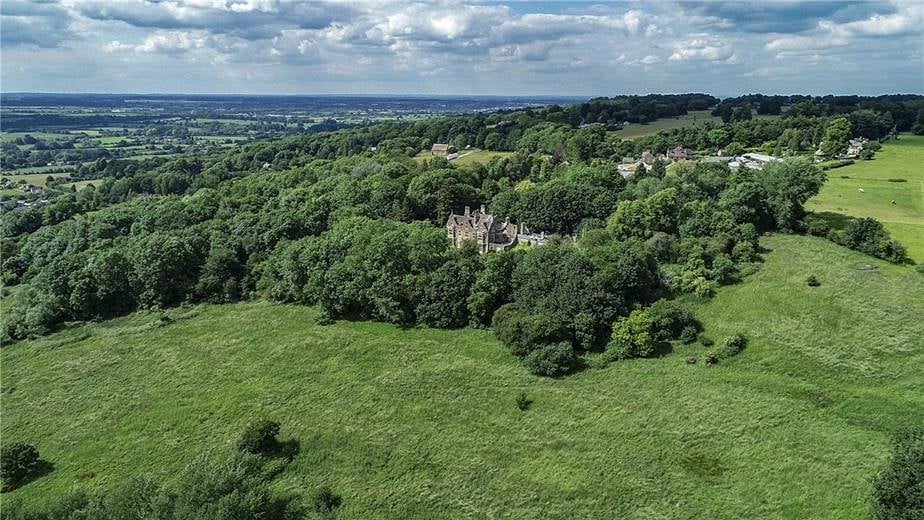
Culver House, New Exeter Street, Chudliegh, Devon
http://chudleighhistorygroup.uk/articles/notable_houses.html
The raising of the Cross in Porto Seguro 1879
Painting by Pedro Peres, 1879. Museu Nacional de Belas Artes – Rio de Janeiro – Pedro Peres – Elevação da Cruz em Porto Seguro, BA, 1879 – óleo sobre tela – 200,5 x 276 cm – assinada P.Peres, 1879 – compra, 1879.
https://en.wikipedia.org/wiki/Discovery_of_Brazil#/media/File:Eleva%C3%A7%C3%A3o_da_Cruz_em_Porto_Seguro
17 Earls Terrace, Kensington, London
https://themovemarket.com/tools/propertyprices/17-earls-terrace-london-w8-6lp
Research Resources
Our Family History Faith Packard (1989)
Alwyn Henry Seppings: Memoir 1932–1946
Seppings, Alwyn Henry 235 n.43, 235 n.46 Seppings, Edmund Henry 235 n.43 Seppings, Henry 47–9 Seppings, Henry Lockyer 235 n.43
https://en.wikisource.org/wiki/1911_Encyclop%C3%A6dia_Britannica/Rangoon
https://en.wikipedia.org/wiki/Anglo-Burmese_people
https://en.wikipedia.org/wiki/British_rule_in_Burma
Henry Lockyer Seppings (b.1893)
https://dokumen.pub/the-collapse-of-british-rule-in-burma-the-civilian-evacuation-and-independence-9781472589736-9781474205375-9781472589743.html
Joy May Seppings born in Prome, Burma, married Keith J Whiting in 1952 in Essex, England.
https://www.myheritage.com/family-trees/west/OYYV743GQD3AOSJFUQGJY7JTLZX6H4I?familyTreeID=1
Nicholas Lockyer Seppings (1810-1887)
Somerset House c. 1720. Location of the Navy Board, Victualling and Sick offices after 1789, engraving by Leonard Knyff & Johannes Kip, in 1795 by Joseph Farington & in 1809 by Rudolph Ackermann https://airspacehistorian.wordpress.com/tag/royal-navy/
Rosa Anna Seppings (1836-1913)
Rosa died 30 Aug 1913 at The Laurels, Cedar Rd, Sutton, Epsom, Surrey.
https://www.wikitree.com/wiki/Seppings-2
Louisa Harriett Seppings (1838-1907) and Walter Amos Michael (1832-1903)
https://www.rootschat.com/forum/index.php?topic=528498.9
https://cartorum.fr/carte-postale/435634/ajaccio-ajaccio-grand-hotel-et-continental-corsica
https://www.proquest.com/openview/f399f7814d085df6318ac5d5011a90f3/1?pq-origsite=gscholar&cbl=1820943
https://allafrica.com/stories/201411080009.html
https://www.faceofmalawi.com/2014/11/07/unima-founding-vice-chancellor-dies/
https://en.wikipedia.org/wiki/Ian_Lockie_Michael
Anna Maria Catherine Seppings (1836-1867) and John Hamilton Merritt (b.1832)
W. H. Allen and Co. – Pope, G. U. (1880), Text-book of Indian History: Geographical Notes, Genealogical Tables, Examination Questions, London: W. H. Allen & Co. Pp. vii, 574, 16 maps
Map of “Madras Presidency” from Pope, G. U. (1880), Text-book of Indian History: Geographical Notes, Genealogical Tables, Examination Questions, London: W. H. Allen & Co. Pp. vii, 574, 16 maps. Scanned from personal copy and uploaded by Fowler&fowler«Talk» 20:58, 6 March 2009 (UTC)
Lt Hugh Henry Yarde (1846-1870)
https://bergergirls.com/getperson.php?personID=I205581&tree=Strausstown
https://www.thegazette.co.uk/London/issue/23004/page/4101/data.pdf
https://www.thegazette.co.uk/London/issue/24911/page/6613/data.pdf
https://en.wikipedia.org/wiki/King%27s_Own_Royal_Regiment_(Lancaster)
Frederick Lockyer Puttock (1861-1891)
https://wiki.fibis.org/w/Bengal_Pilot_Service
https://www.wikitree.com/genealogy/PUTTOCK




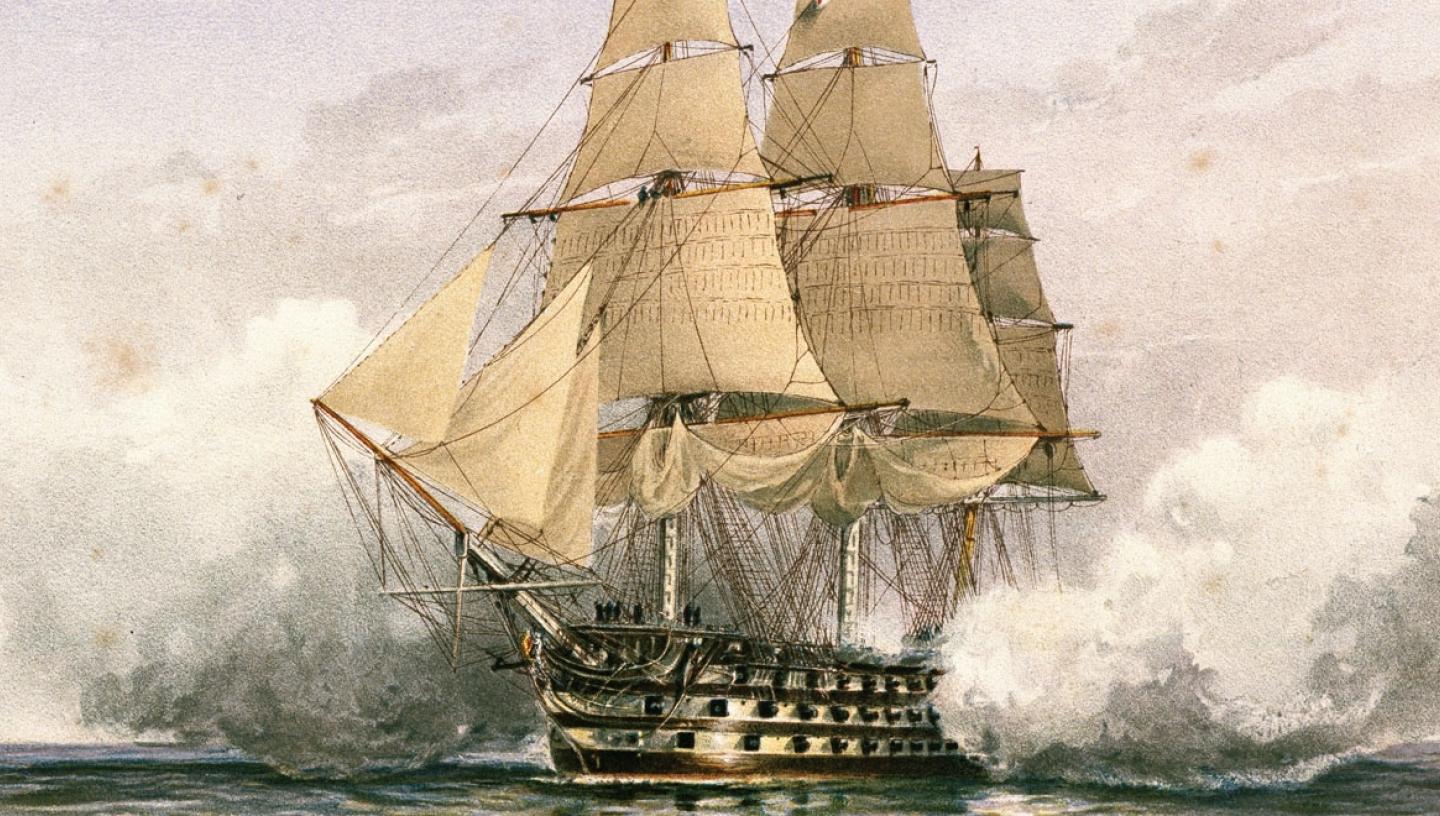

































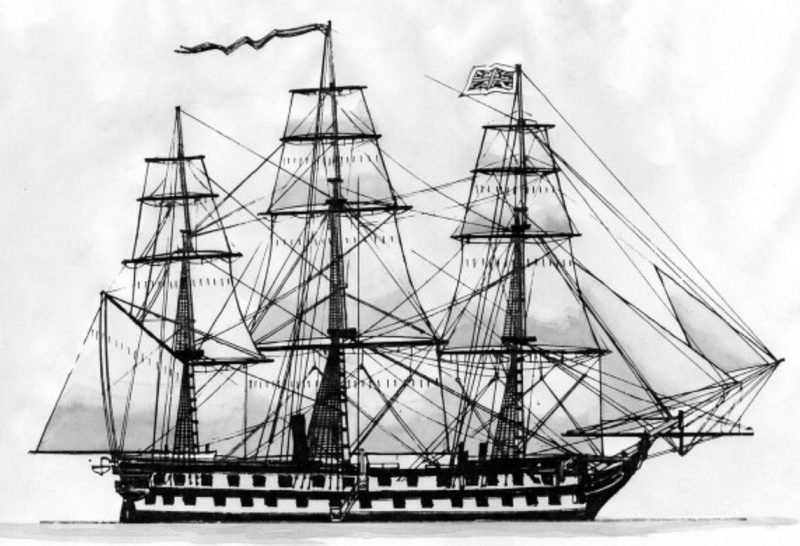




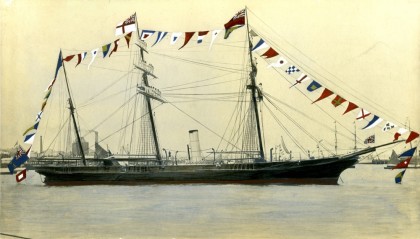


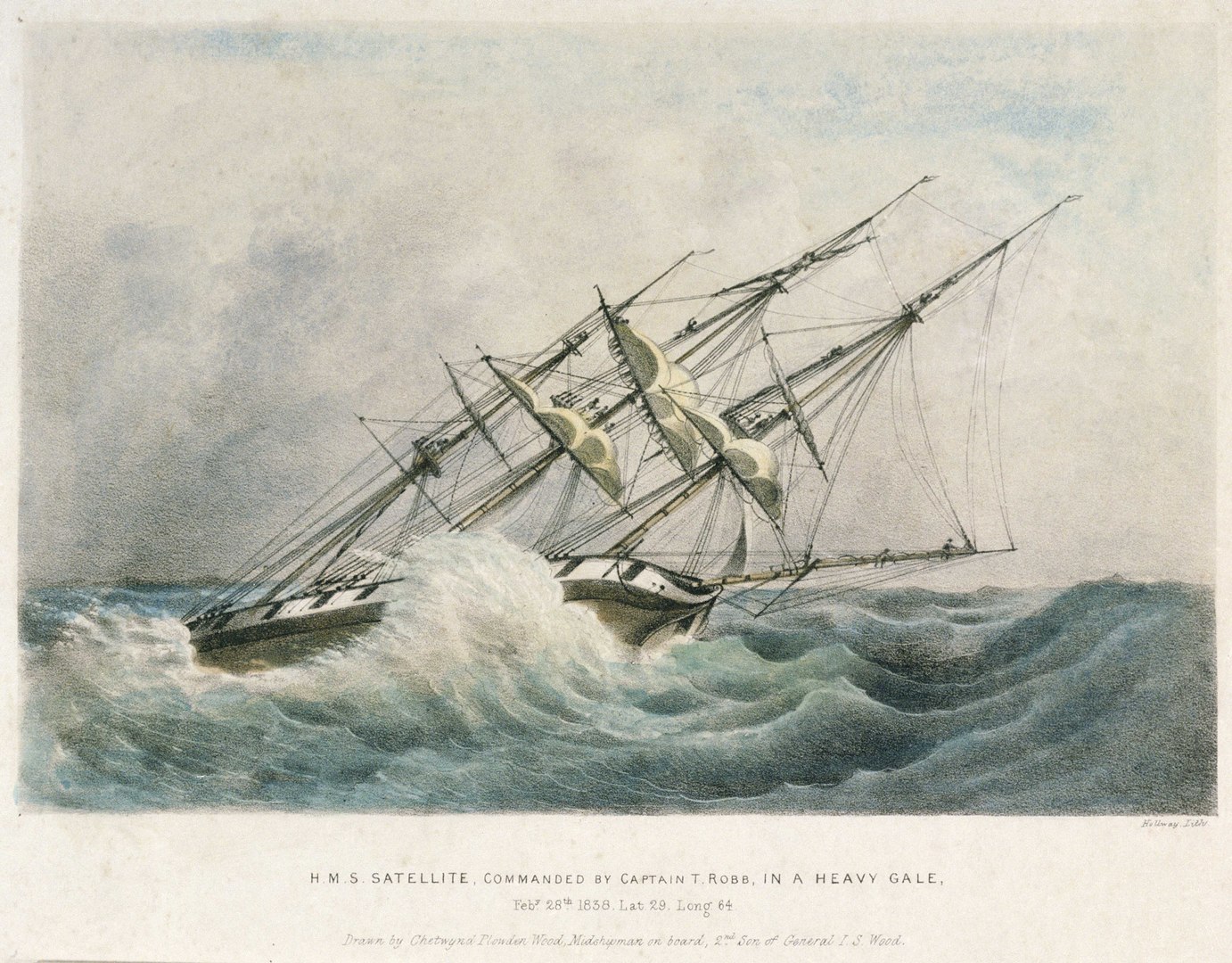













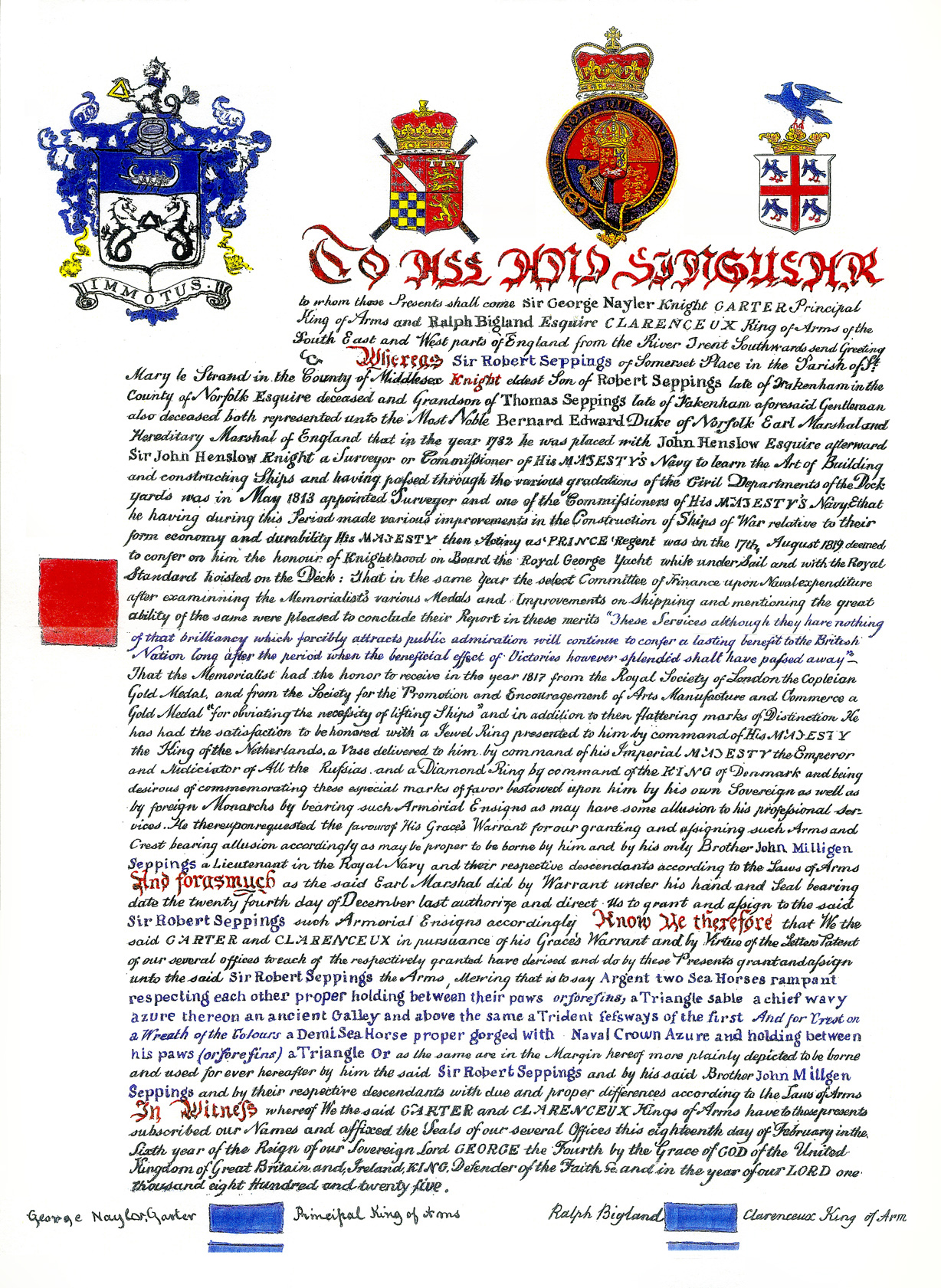
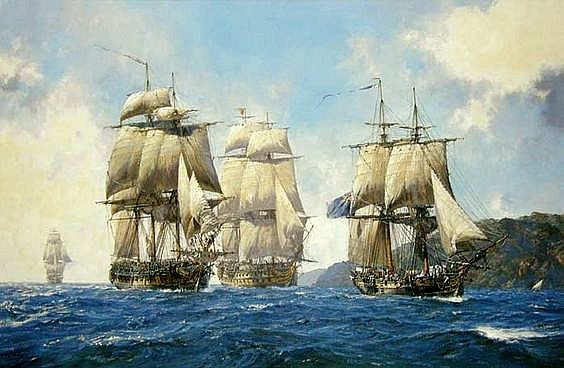
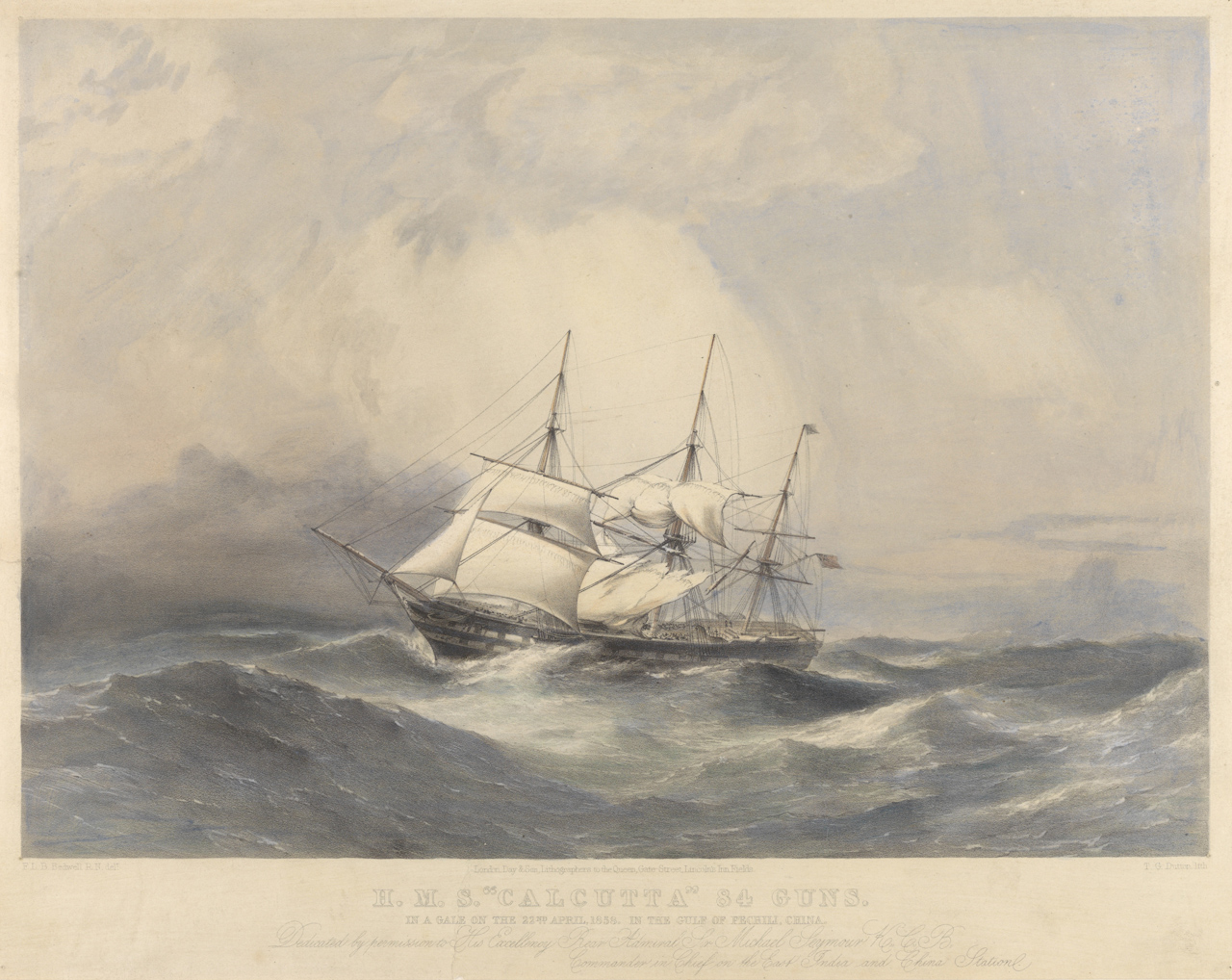
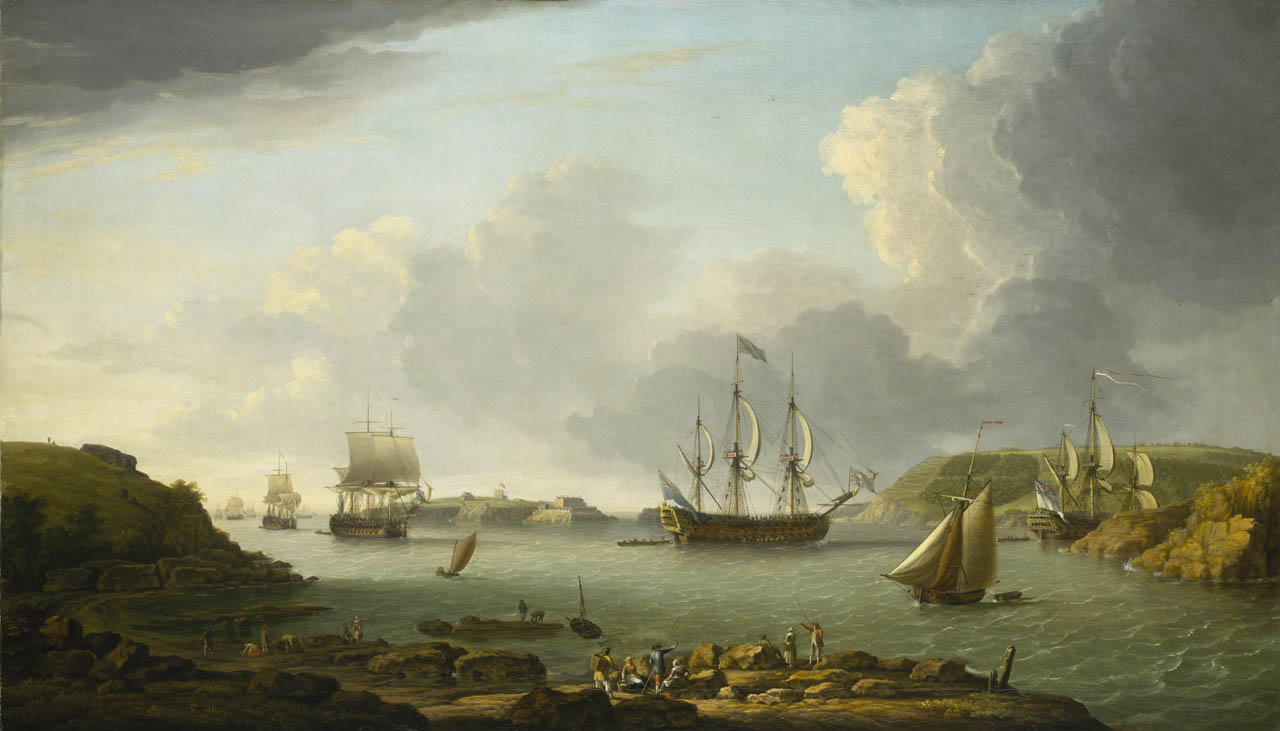
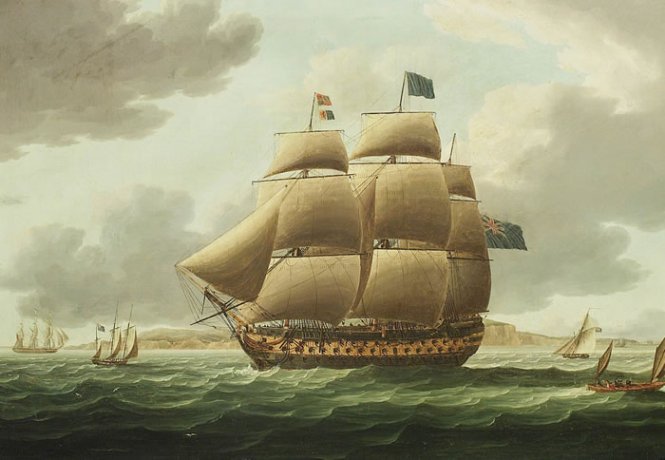
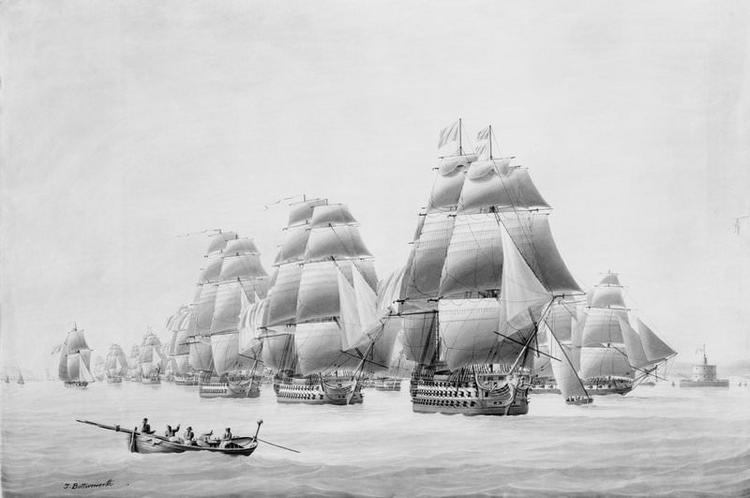 HMS Ville de Paris (1803). Lt John Milligen Seppings served under Lord St Vincent on his 1st Rate (104) Ville de Paris from Oct 1798 to Jan 1801 in the Mediterranean and off the Coast of France in a line of Battle ships off Cadiz and Brest. Ville de Paris was designed by Sir John Henslow
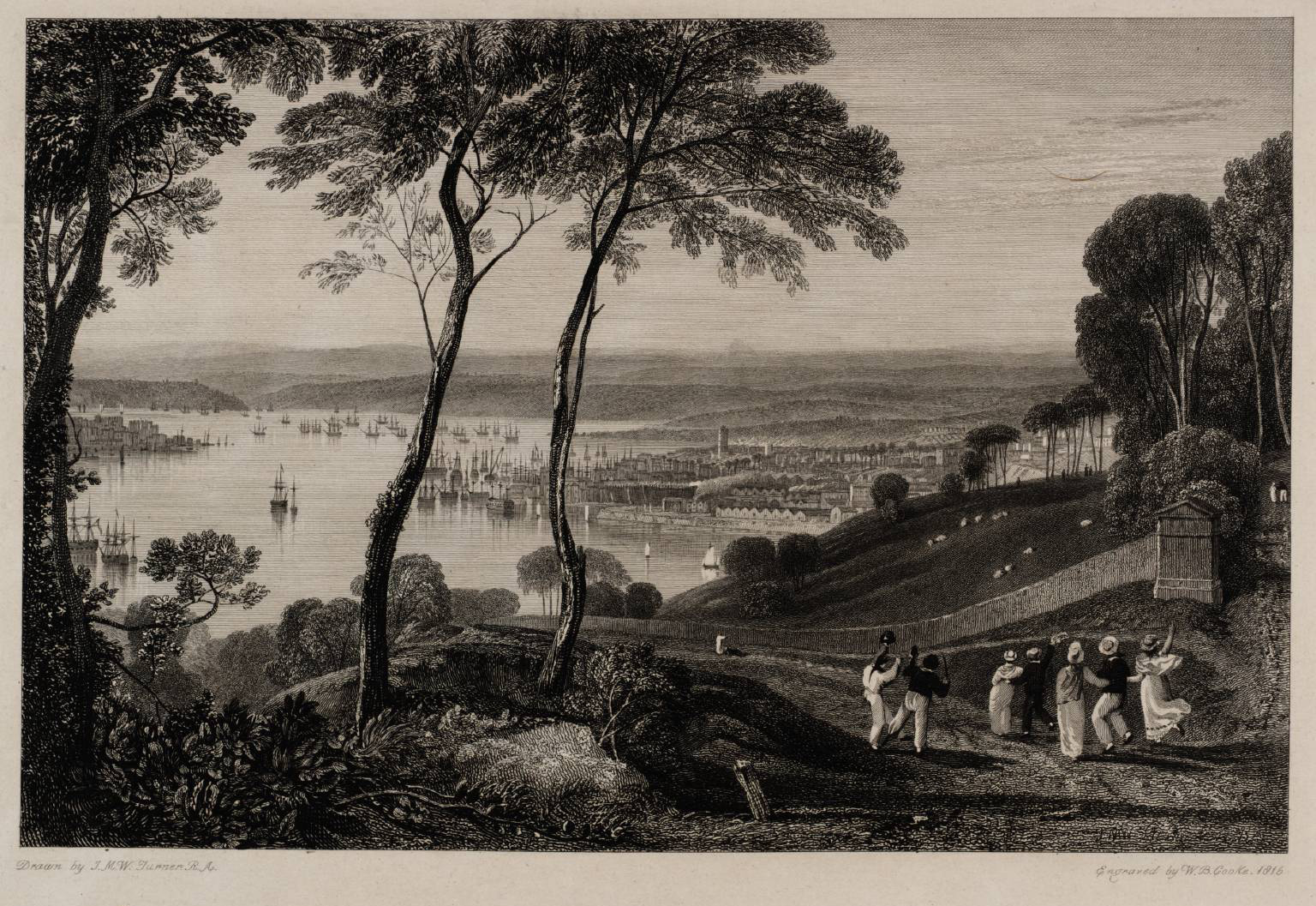
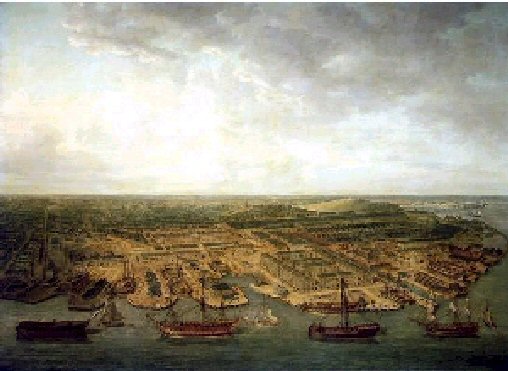
 Plymouth’s shipyards (1700s)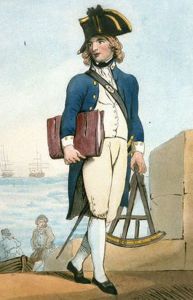


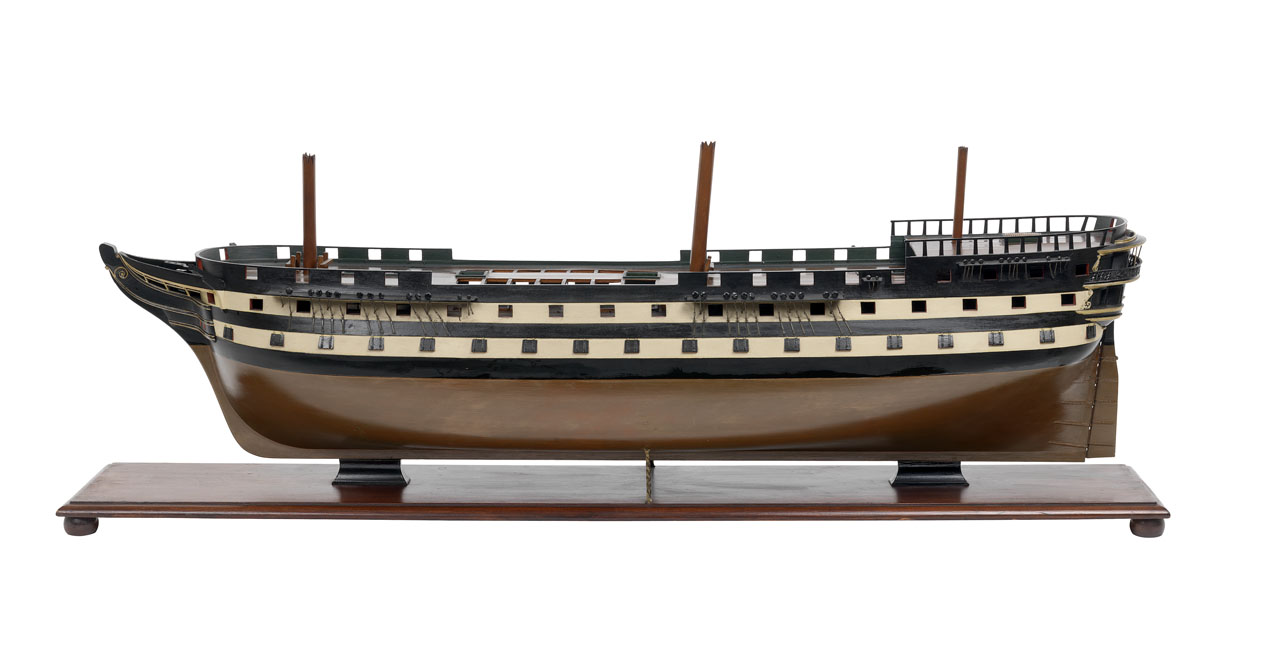 HMS Rodney (1833) Warship Second rate 92 guns designed by Sir Robert Seppings






 A truss of ‘diagonal riders’ stiffened the hull
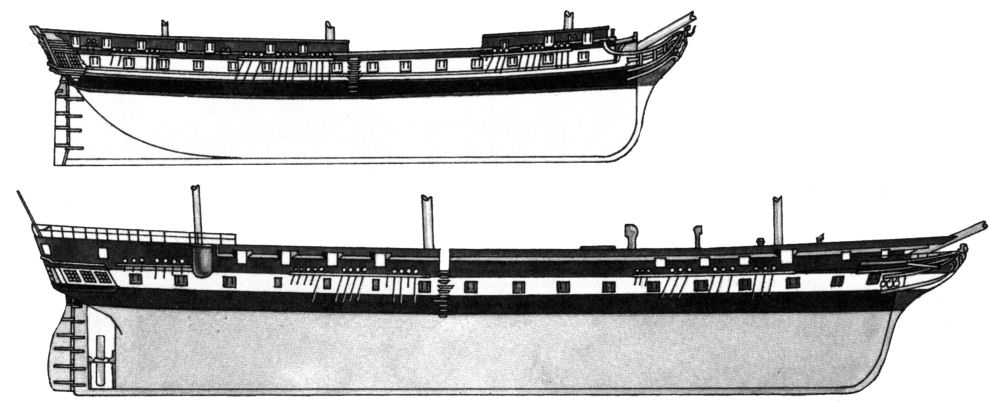 A conventional frigate compared with the much longer ship made possible by the ‘Seppings’ system of construction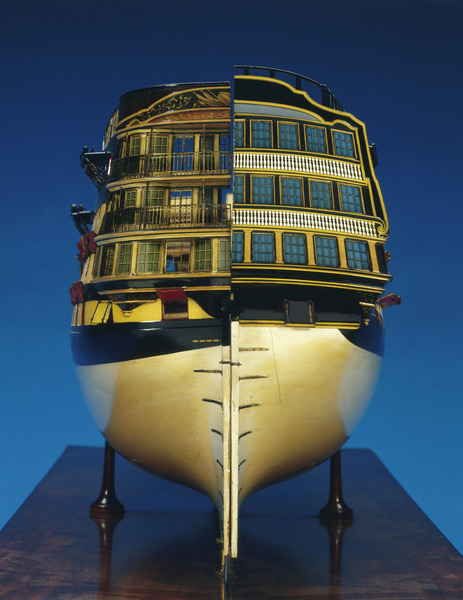
 Model of Caledonia 1808 ship of the line, with square bow and stern next to the round bow and stern system introduced by Sir Robert Seppings. The framing of Seppings’ circular stern


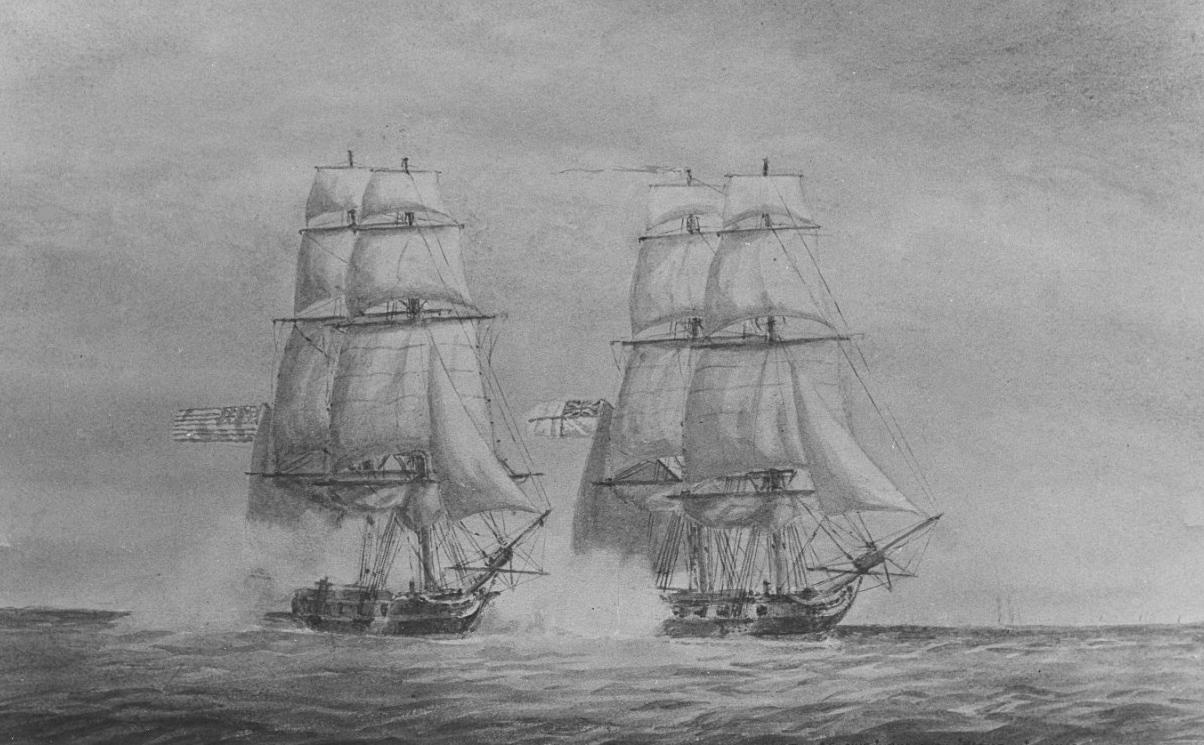
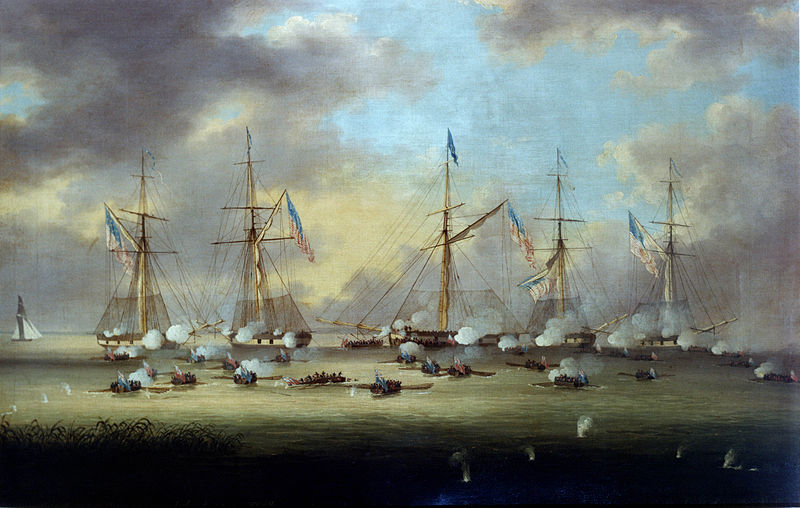 Capt Nicholas Lockyer led the advance in the Battle of Lake Borgne, Louisiana, between British and American naval forces in the War of 1812.




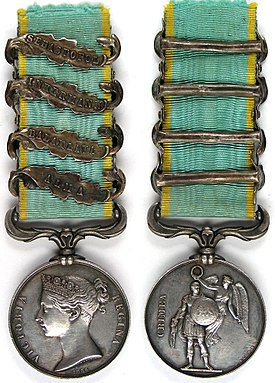
 71st Regiment of Foot
 Seppings Family History


