The Lockyer Homes – England

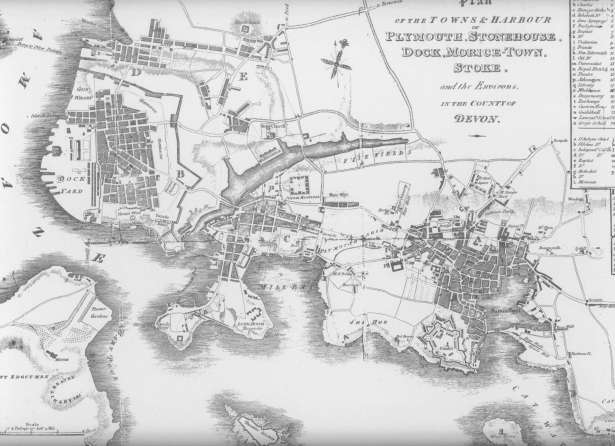
Plymouth_map_nile_1820a s
Map of Plymouth (1820)

When our Milligen, Lockyer and Seppings ancestors lived in Plymouth, Devon, it was one of the largest seaports in England. ‘On the west bank was Plymouth Dock, renamed Devonport in 1824, the site of a major naval base and dockyard, which had grown spectacularly during the eighteenth century so that by 1801 its population exceeded that of Plymouth.’ Near the smaller town of Stonehouse were the royal marine barracks, naval hospital and victualling yard. Between 1812 and 1844 the mile-long breakwater was constructed, which created ‘one of the largest and safest harbours in Britain’. (1)

Lockyer – Plymouth

Plymouth Barbican_Victorian
In the late 1700s, the Lockyer family lived in the Island House, on Southside Quay, Plymouth, the stand alone building in the centre of this photo (1890)

Ann Marshall Lockyer was born in Plymouth, Devon, 1782, the fourth of eleven children, named after her mother, Ann Grose. Her father, Thomas Lockyer (b. 1756 Plymouth) was a successful Sailmaker and Ship Riggings Merchant who rented a ‘Plot of ground on which have been erected warehouses’ on Southside Street, Plymouth, ‘Conventionery rent – 1 pound, 5 shillings; 20 pounds fine paid on last renewal 8 Apr 1801’. (2)
He also rented the Island House on Southside Quay, Plymouth, where the family lived. There is a record showing he paid £240 on 23 December 1796 for building and … (possibly adjacent buildings and the lands appropriated to the use of the household).
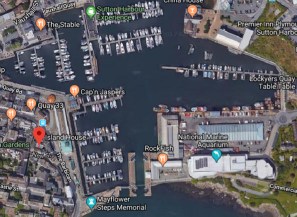
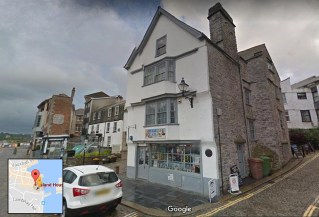
The Island House_Plymouth_Satelite map_a s Island House_The Barbican_Plymouth_05_crop s
Island House_The Barbican_Plymouth_01_crop s Island House_The Barbican_Plymouth_04_crop s
The Island House is one of the principle buildings of historic interest on The Barbican, Plymouth, today.

Island House, No 9 The Barbican, named because it has a road around it, was constructed by Mr Johnathon Sparke and is dated as early as 1572 when the quayside was built. It was one of the houses where the Pilgrim Fathers lodged prior to their final departure for America on September 6th 1620 in the Mayflower. (3) Sir William Molesworth, an heir of Mr Sparke, leased the Island House to the Bayly family who, in 1786, purchased the freehold. It is possible that Thomas Lockyer rented the house from the Bayly family soon after when they moved to a new property further along the Barbican.

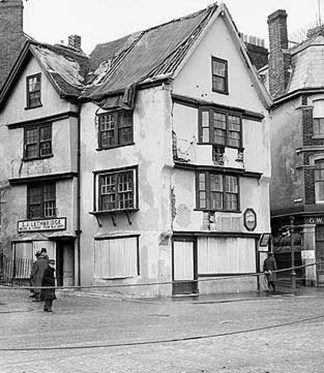
pinsdaddy-plymouth-barbican-island-house-18 Island House_Plymouth_the Blitz_1941_crop
Island House, Plymouth, late 1800s and after the Blitz (1941)

The Elizabethan house survived the destruction of Plymouth in the Blitz, but during an air raid on the night of 13th/14th January, 1941, it sustained considerable damage and was restored in 1948 and again in 1992.
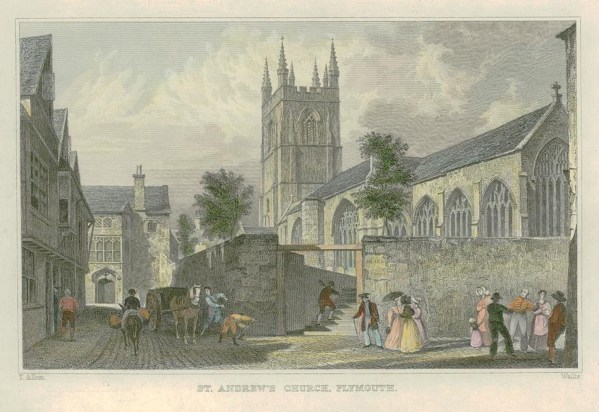
Plymouth_St Andrews Church_handpainted_1832 s
St Andrews Church, Plymouth (1832)

Thomas and Ann Lockyer’s children were all baptised in St Andrews Church, Plymouth. Of the seven boys, one became a mayor of Plymouth, one was the Comptroller of Customs, Plymouth, one became a Captain, one a Brigadier General and two were Majors in the Royal Navy, and one was a solicitor in London. All were married. Ann Marshall Lockyer married Lt John Milligen Seppings at Charles the Martyr, Plymouth, in 1804. Her elder sister had died in infancy but her two younger sisters, Eliza Maria Lockyer (b. 1791), married in 1809 in Wembury to Henry Allworth Meriwether esq. of the Inner Temple, London, an Attorney General and Town Clerk of London, and Jane Edwards Lockyer (b. 1793), married Edward Hobson Vitruvius Lawes esq. of the Inner Temple, London, Barrister at Law, in 1815.

Lockyer – Wembury
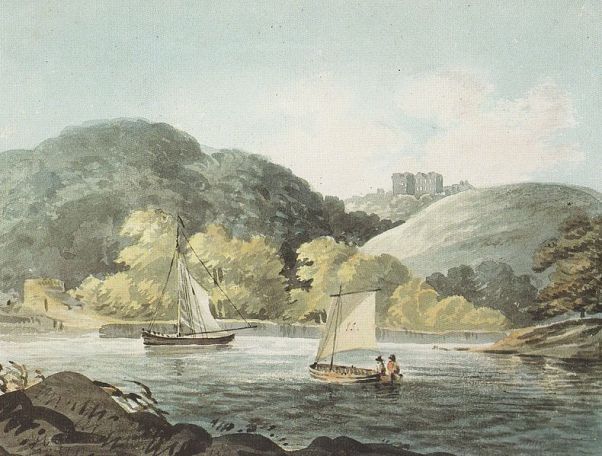
WemburyHouse_Devon_1797_ByRevJohnSwete
Coastal view of Wembury House ruins high up in the distance. 1797 watercolour by Rev. John Swete

Wembury House

In 1802, Thomas Lockyer bought a property out of Wembury village on the south coast of Devon, close to Plymouth Sound. Wembury is six miles from Plymouth and was an area of  ‘medieval manors, open fields, and the emergence of substantial agricultural estates’. (4) With a population of around 400, they were ‘structured in a strict social hierarchy’. A few prominent landowners controlled the estates; beneath them were their tenant farmers and a large agricultural labour community lived in settlements of rented cottages.

In The History of Devonshire Vol 3 (1806) Richard Polwhele writes that Thomas Lockyer paid £26,500 plus £1,500 for the timber at auction for the property which included the ruins of Wembury House, 890 acres, an additional rental manor, and a ‘valuable fishery’. The immense tidal fishpond on the Yealm Estuary, which ‘contrived so as to be stored with fish by the influx of the tide, and closed by the floodgates, which prevented their return to the ocean’ included ‘every sort of fish that frequented the coast’. (5)
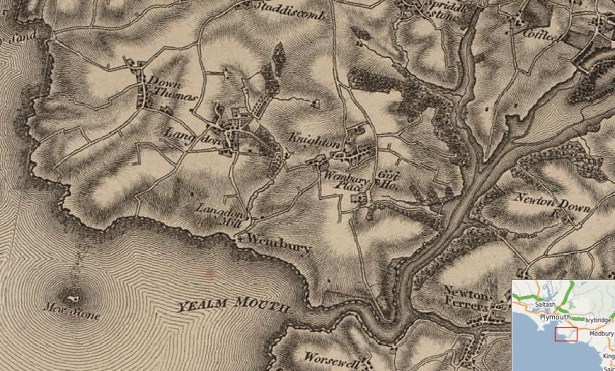
Wembury_map_1809b
‘Wembury Place’ is Wembury House (1809)

The property is described on the Wembury House website as in ‘unspoilt countryside in the South Hams which is designated as an “area of outstanding natural beauty”. Set at the top of a valley it has views down to the Yealm estuary.’ Wembury House has a long and distinguished history dating back to the Augustinian Priory of Plympton, founded in 1121. From the remains of a cell of the priory, the first Wembury House, built by Sir John Hele, was a ‘16th century mansion of legendary grandeur’ and one of the most important houses in the parish. An exceptionally grand multi-storey mansion, it was recorded in the Devon Hearth Tax of 1674 as having 42 hearths – the largest number recorded in any house in Devon. (6)

In 1685, John Pollexfen began to remodel and rebuild the Elizabethan house with ‘elaborate gardens and landscaped parks’ but later generations of his family could not afford to maintain it. John Pollexfen’s granddaughter sold Wembury House in 1757 to Sir William Molesworth who had also owned the Island House in Plymouth where Thomas Lockyer and family lived. By 1797, the diarist John Swete described the manor as ‘in a state of great decay if not entirely dilapidated’. Sir William Molesworth’s daughter was the heiress to his estates and married Earl Camden who sold the Wembury House property to Thomas Lockyer in 1802.

In 1803, the recently retired Merchant decided to demolish the ruin and start again. Polwhele recorded the disposal and removal of materials which Thomas sold for eight hundred pounds, including the gilded sash window frames and the Portland stone facing to the walls (possibly reused in Traine Farm). The Barton Farm, in front of the ruin, was also demolished and landscaped as a park. He then built the present Old Barton Farm and New Barton Farms, splitting the land between them. A member of the Wembury Local History Society, Robert Rowland from Traine Farm explained, ‘A Barton was originally a large farm that grew barley ie Barleytown or barleyton. Wembury Barton was about 400 acres so Thomas made two farms of it and built the farmhouses and barns accordingly. There is an L for Lockyer in the centre of the front wall of one of the barns at Old Barton.’

The Devon Rural Archive describes the late Georgian Manor House built for Thomas Lockyer between 1803 and 1806 as ‘on the lower terrace of a split-level site on a very exposed hilltop site, evidently chosen for its wide views … A large walled area to the west, apparently belonging to the late C16 period encloses a garden of varying levels with a gently sloping central lawn, scarped away to the present house. A raised buttressed terrace at its west end was crenellated and seems to have formed part of a formal garden associated with Sir Hele’s mansion. Flanking walls and tree belts protect the house and its gardens from westerly winds, with a small gothic lodge to the north. Many architectural fragments of the earlier houses are built into these walls. Large walled gardens lie in the valley to the east, at the foot of which is the large tidal fishpond.’ There are several outbuildings including gardeners’ bothy, stables and associated buildings, an orangery and well-house. An earthwork Rampart, or raised terrace, located across the lawn in front of the present house are surviving remains from Sir John Hele’s 16th century house, as are the kitchen garden, conservatory and a pavilion.

Wembury House_garden_archway and steps
Steps to Ramparts, Wembury House. An archway beneath the central steps of the terrace, now walled up, is said to have led to the sea via an underground passage.

Thomas Lockyer’s Wembury House is of national importance. In the Wembury Heritage Data Base, it has two storeys plus attic and basement, built of rubble with ashlar dressing, a slate hipped roof, and rusticated quoins. There is also a Tuscan porch with cast-iron balcony. It has a Grade II National Heritage Listing for the building, garden boundary walls and two pairs of gate piers north-west and south-east, two pairs of gate piers and link walls 230 metres north-north-east, kitchen garden walls built of stone rubble and gate piers with moulded caps and ball finials and ornamental wrought iron gates, thirteen buttresses on the outer wall terrace, steps on leading down to lawn and more buttresses at the sides.
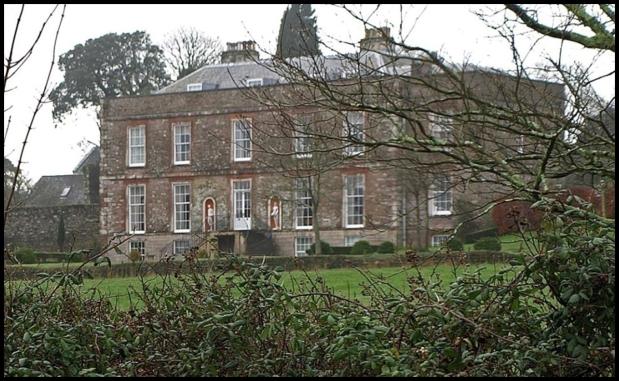
Wembury House_Robert Rowland archiveWembury House

On 9 Aug 1806, Thomas Lockyer died after being thrown out of his carriage and the wheel rolling over his leg which became gangrenous. He was buried on 15 August in the floor of the North aisle of St Werburgh’s Church, Wembury. Thomas’s death led to the manor being advertised for sale in Trewman’s Exeter Flying Post on the 14 July 1808, with the land increased to 946 acres. It was described as including ‘a new-built mansion house, with lawn in front, a coach-house and suitable stabling … a bowling green, and a most elegant vinery and plant-house … Also, the Ferriage or Passage over the Haven and River of Yealme, called Shepeing Ferry, with the Tolls and Dues of the said River, and the Water, Piscary, Fishing, Oysterage, and Royalty of, in, and through the same’.

According to Faith Packard in Our Family History, Edmund Henry Seppings was brought up by his grandmother, Ann Lockyer, in Wembury, and kept his cousin, William (Edmund Lockyer’s first born), a year younger, company. Edmund and William also spent time together in Australia in the early 1840s.

Wembury House_website_banner

Wembury House – see www.wembury.com for more interior photos

On 23 June 1809, a document was drawn up to enable partial sale of the estate to Thomas’ brother, William Lockyer of Plymouth, merchant. The sale included West Wembury farm – a large farmhouse built of slate rubble with granite quoins and slate hung front; slate roof with gabled ends, (Rider’s, Hercules’ and Willing’s tenements) Lye’s or Warren’s, Luke’s, Witherage’s, and Nicholas’s tenements, Kelly’s Garden and Furze Park, Wembury Mill, cottages and gardens, Rowe’s, Prinn’s and Tregosses’s tenements, North Ditch and Good House or Kimber’s tenement, Saffron Park, Higher and Lower Church Park, the Old Inn public house, Freesland and Wood Park in Wembury.

West Wembury Farm_1927
West Wembury Farm (late 18th century)

‘Thomas junior was in need of funds to complete the building work on the house etc. and to fulfill the terms of his Father’s Will.  In those days they could not just sell the freehold, they had to do something called Lease and Release in two documents,’ explains Robert Rowland. The Lease was 25 shillings and one peppercorn! Listed on the document in The National Archives are Thomas’ brother Edmund Lockyer of Plymouth, esq, John Harris the younger of Radford, Plymstock, esq, Samuel Wroth of Modbury, maltster, Henry Rivers the younger of Stowford, gent, and Thomas Lockyer (junior) of Wembury House, Wembury, esq, who would have been the executors of Thomas senior’s Will. (7)
‘It is a bit confusing as to which Edmund, William or Thomas they refer as the names occur in both generations. Edmund 1782-1816 was a very important figure in Plymouth so would have taken the lead as head of the family.’

On 26 May 1814, the manor was again offered for sale in Trewman’s Exeter Flying Post, reduced to 550 acres. ‘All the doors of the sitting and best bedrooms, 24 in number, are made of a very beautiful Spanish mahogany’ while to the rear was ‘a mount or terrace, about 300 feet in length, 30 feet wide and 30 feet high, commanding extensive views of the ocean’. The Calmadys bought West Wembury from William Lockyer in 1814, extending the Langdon Estate, but the manor house was not sold until 1822, following the death of Thomas Lockyer’s wife, Ann, in December 1820, to the diplomat Sir Edward Thornton. (8)

Thorn House (South Wembury House/Lockyers Cottage)
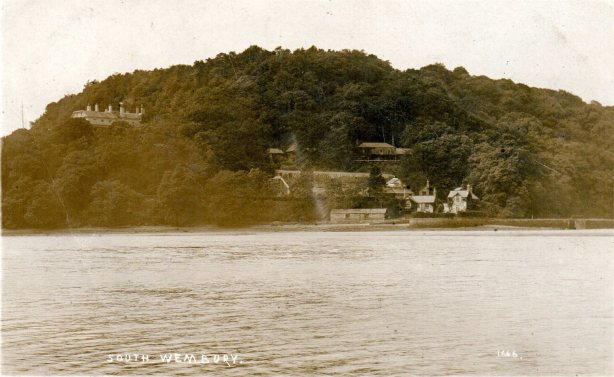
THORN FROM THE RIVER_1910s_postcard_1914_Thorn House, in isolation on the left_Fishpond Cottage and Boathouse Cottage
A 1914 postcard of Thorn House, on the left, and in the mid ground, on the river bank, Fishpond Cottage and Boathouse Cottage, above them is one of the walled gardens and above that, the stables.

It is possible the Lockyer family lived at Lockyers Cottage while the new Wembury House was being built. Wembury Local History Society member, Robert Rowland, wrote, ‘Lockyers Cottage has had several different names – South Wembury House, South Wembury Court, and now Thorn. It was originally the gate house to the first Wembury House built by Sir John Hele. It is situated by the River Yealm as everything in the early days came via the river. In the Hearth Tax returns of 1662 it was recorded as having 13 fire hearths, quite a substantial property, as most people had one or two. Wembury House was sold off, but the family kept the estate and moved permanently to Lockyers Cottage.’

After Thomas Lockyer’s death, his son, Thomas, moved into what became the new manor house, South Wembury House, overlooking the Yealm, and soon afterwards 536 acres were transfered from the ‘Manor of Wembury’. (9) According to A.G. Collings in A Wembury History – Medieval to Modern, ‘Lockyer’s Cottage’ on the tithe map was depicted as a small structure, but was to be considerably extended by the 1860s. The building was by then the very imposing ‘South Wembury House’ with garden buildings to north and south.’

On the Thorn House and Garden website, it says ‘the exact date of the present house is unknown, however it is on the site of an earlier building which goes back centuries as evidenced by the existence of Tudor cellars. South Wembury House was refurbished in the early 19th century by Thomas Lockyer.’

17760886_1671297446499827_5817706478735086094_o
The ‘Gifthouse’ was the Hele Almshouses. ‘Wembury’ is Wembury House. The other buildings shown are St Werburgh’s Church and Langdon House (1765)

Sir Warwick Hele of Wembury, in his will of 1625, established a charity which ‘appointed and ordained 10 poor people to be kept and maintained in his alms house at Wembury for ever, to be chosen and appointed by him that should be owner of South Wembury House’. (10) In 1806, when Thomas Lockyer succeeded his father in South Wembury estate, there were nine women in the almshouse. In 1812, according to The Charities in the County of Devon, ‘the buildings being in a very dilapidated state, it became necessary to lay out a considerable sum upon them; whereupon Mr. Lockyer, the owner of South Wembury House, advanced the ‘money required, without interest, intending to reimburse himself out of savings arising from vacancies among the alms-people, without discharging any, or stopping their allowances. He has also, at various times, permitted his own materials to be used in the buildings. From his account it appears, that the sum expended in repairs since 1808, amounts to 67 l. 9s. 2; d. The alms people consist of women who are old and very poor … and we are told by Mr. Lockyer, that he proposes to select such poor old persons, of either sex. The alms-people are each paid, quarterly, 15s.’
The Ecclesiastical Chapel at Hele Almshouses in the centre of a row of six rubblestone Residential Hele Almshouses (Listed) were built close to Wembury House by Sir Warwick Hele circa 1590 and are still in use.

The road to Wembury House is described in The Tourists Companion Being a Guide to Plymouth, 1823, as ‘the elegant modern residence of Thomas Lockyer, Esq. commanding extensive prospects over the fertile districts along the banks of the Yealm.’ It then takes us on a short walk ‘to the mouth of that river, where we cross to Newton Ferrers, by the help of a ferry-boat. This village, whose pleasing and salubrious situation renders it a favourite retirement for naval officers, is placed on the banks of the estuary.’

‘The 1851 census confirms the presence of high-status residences in the parish,’ writes A. G. Gollings. ‘Charles Calmady at Langdon Hall farmed 850 acres, while Sir Edward Thornton still occupied Wembury House and Thomas Lockyer occupied South Wembury House’ and owned the Old and New Bartons.

Thorn House_paintingSouth Wembury House (now Thorn House)

The Thorn House and Garden website reveals, ‘In 1876 Richard Cory, a wealthy London coal merchant, bought the South Wembury estate from the Lockyers. The Cory’s added a ballroom and billiard room; guests included the Prince of Wales and his brother the Duke of Edinburgh. In 1920 the house was sold to William Arkwright, who renamed it ‘Thorn’.’ He developed terraces and formal grounds in imitation of those at Sutton Scarsdale. The next owner, the Hon. Mrs Ida Marie Sebag-Montefiore, an enthusiastic horticulturalist, added more. When she left Thorn in 1938, she gave some of the land to the National Trust and the estate was gradually broken up into smaller units. John and Eva Gibson have lived at Thorn since 1981.
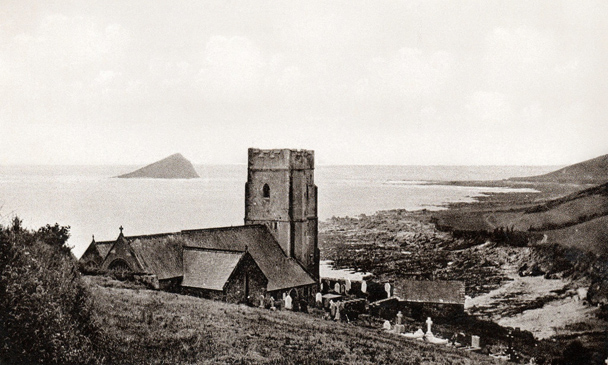
St Werburgh's Church_Wembury_a s
St Werburgh’s church, Wembury (1943)

Thomas and Ann Lockyer, and their son Thomas and his wife Jane Lockyer are buried in St Werburgh’s church, Wembury, and commemorated on wall plaques. The Parish Church, overlooking Wembury Beach, is Grade 1 listed and dates from at least the 14th century.

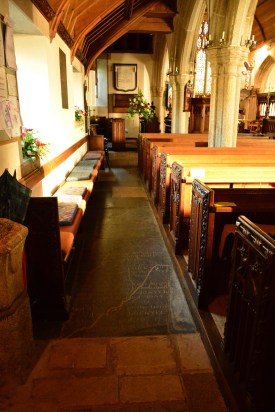
Lockyer_Thomas_memorial slab Wembury_St Werburgh's Church_North Aisle_Sue Carylon photo_2017 s
Lockyer memorial ledger inside St Werburgh’s church, Wembury, North Aisle

Transcription –
THOMAS LOCKYER ESQ died August 9th 1806 Aged 49 Years
ANN wife of the Said THOMAS LOCKYER Died 8th of December 1820 Aged 65 Years Also THOMAS LOCKYER ESQ Eldest son of the above named THOMAS & ANN LOCKYER who died April 29th 1859 Aged 76 Years
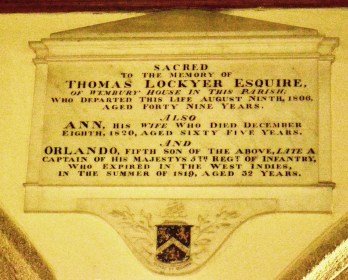
Lockyer_Thomas, Ann, Orlando_Wembury_St Werburgh's Church_Sue Carylon photo_2017a s Lockyer_Thomas & Jane_Wembury_St Werburgh's Church_Sue Carylon photo_2017 s
Lockyer memorial wall plaques inside St Werburgh’s church, Wembury

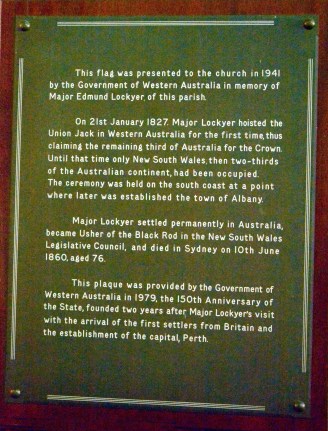
Major Edmund Lockyer, the third son of Thomas and Ann, was famous for raising the British flag in Albany, Western Australia, on 21st January 1827 and claiming it for the Crown. In the south aisle of St Werburgh’s church is an Australian flag and Western Australian flag. The WA flag was presented to St Werburgh’s in 1941 by the Australian Government to commemorate Edmund Lockyer’s deed. The Australian flag was presented to the church in 1979. Edmund Lockyer’s first son, William, was christened at Wembury House in 1808.
Lockyer_Edmund_Wembury_St Werburgh's Church_Flag1_Sue Carylon photo s Lockyer_Edmund_Wembury_St Werburgh's Church_Flag2_Sue Carylon photo s
In the south aisle of St Werburgh’s church is a plaque and a Western Australian flag commemorating Major Edmund Lockyer.
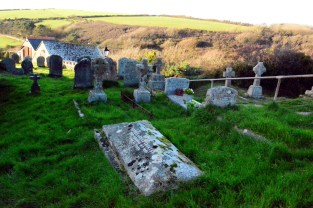
Lockyer_James_grave_Wembury_St Werburgh's Church_Sue Carylon photo_2017_01 s Lockyer_James_grave_Wembury_St Werburgh's Church_Sue Carylon photo_2017_02 s
In the old yard of St Werburgh’s church is Thomas and Jane Lockyer’s youngest son James Lawes Lockyer’s grave.

Members of Thomas Lockyer’s family were Mayors of Plymouth on 9 occasions.
Thomas’ brother Edmund Lockyer was a prominent lawyer in Plymouth and was responsible for building the Royal Theatre and the Plymouth Atheneum in ‘grand Palladian style,’ but it was all lost in WW2. (11) The Lockyer’s are remembered in Plymouth with Lockyer Street, Lockyer Court, Lockyer Road, Lockyers Quay, the once Lockyer Hospital, Lockyers Quay Pub Restaurant and Lockyer House B & B.
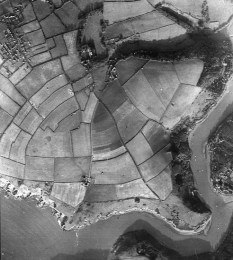
a-Wembury-Cliffs-and-Yealm-Estuary_edited-1-492x550 Thorn House_aerial
Wembury House, Thorn House and the River Yealm, Wembury

Photo & Illustration Credits

‘Map of Plymouth, Devon’ Engraved by John Cooke (1820)
‘Southside Quay, Plymouth’ (1890) www.pinsdaddy.com/old-photos-of-plymouth-uk
Google Maps Images – Island House, The Barbican, Plymouth
‘Island House, Plymouth, late 1800s’ www.visitthepast.co.uk
‘Island House, Plymouth, after the Blitz’ (1941) www.pinterest.com
‘St Andrews Church, Plymouth’ hand-painted steel engraving drawn by Thomas Allom and engraved by Wallis for “Devonshire Illustrated” (1832)
‘Wembury’ watercolour by Rev. John Swete (1797) – Devon Record Office
Wembury map (1809) Ordinance Survey First Series, Sheet 24
‘Steps to Ramparts, Wembury House’ www.wembury.com
‘Wembury House’ photograph by Robert Rowland, Traine Farm – Wembury Local History Society
Wembury House photos – www.wembury.com
‘West Wembury Farm late 18th century’ Wembury Local History Society
‘South Wembury’ postcard (1914)
Benjamin Donn’s map of Devon (1765 ) www.geographicus.com
‘South Wembury House’ (now Thorn House) thornhouse.co.uk/history
‘St Werburgh’s church, Wembury (1943)’ Wembury Local History Society
‘Lockyer memorial ledger’ photograph by Wembury Local History Society
‘Inside St Werburgh’s church, Wembury’ photograph by Sue Carlyon, Wembury Local History Society (2017)
‘Lockyer memorial wall plaques’ photographs by Sue Carlyon, Wembury Local History Society (2017)
‘Plaque commemorating Major Edmund Lockyer’ photograph by Sue Carlyon, Wembury Local History Society (2017)
‘Western Australian flag’ photo by Sue Carlyon, Wembury Local History Society (2017)
‘James Lawes Lockyer’s grave’ two photos by Sue Carlyon, Wembury Local History Society (2017)
‘Wembury House, Thorn House and the River Yealm’ (1946) photograph – Wembury Local History Society
‘Thorn House and the River Yealm, Wembury’ photograph thornhouse.co.uk

Research Resources

http://www.wembury.com/

http://wemburyhistory.org.uk/
Wembury Local History Society –
Sue Carlyon and Peter Lugar, Wembury, Devon
Robert & Sheila Rowland Traine Farm, Wembury, Devon
http://wemburyhistory.org.uk/wp-content/uploads/2013/03/A-Wembury-History.pdf
http://wemburyhistory.org.uk/2013/05/wembury-house-4/
http://wemburyhistory.org.uk/aboutwembury/agriculture-rural-society/
http://wemburyhistory.org.uk/wp-content/uploads/2016/04/Wemburys-Listed-Buildings-2016.pdf
http://wemburyhistory.org.uk/wp-content/uploads/2013/03/Wembury-Heritage-Database-maps.pdf
http://wemburyhistory.org.uk/wp-content/uploads/2014/02/Wembury-Heritage-Database.pdf

(1) Brian Moseley, Plymouth
http://www.oldplymouth.uk/Barbican%20(The)-09-Island%20House.htm
(2) The Charities in the County of Devon 1839 James Newman, London
Great Britain. Commissioners for Inquiring Concerning Charities 
(3) Brian Moseley, Plymouth
http://www.oldplymouth.uk/Barbican%20(The)-09-Island%20House.htm
(4) Wembury Local History Society
http://wemburyhistory.org.uk/aboutwembury/agriculture-rural-society/
(5) The Reverend Daniel Lysons, Topographical and Historical Account of Devonshire, London, 1822, p.549
Wembury House, Devon: ‘a house of legendary grandeur’.
https://www.thefreelibrary.com/Wembury+House%2C+Devon%3A+%27a+house+of+legendary+grandeur%27.-a0107277545
(6) T.L. Stoate, Devon Hearth Tax Returns 1674, Bristol, 1982, p. IX.
http://www.devonruralarchive.com/Wembury.html
(7) Wembury Deeds (Ref 447)  http://discovery.nationalarchives.gov.uk/
(8) Mills, J., Rowland, R. & M., & Broughton, P. 2000 Wembury at the First Millennium: A Description of the Domesday Manors of Wembury Parish in Devonshire p 21
(9) 19th Century Thorn http://thornhouse.co.uk/history.html
(10) The Charities in the County of Devon 1839 James Newman, London
Great Britain. Commissioners for Inquiring Concerning Charities
(11) Wembury Local History Society member, Robert Rowland.

Richard Polwhele, The History of Devonshire (3 vols, 1797-1806)
A genealogical and heraldic history of the extinct and dormant baronetcies of England By John Burke 1 January 1838
The History of Parliament: the House of Commons 1820-1832, ed. D.R. Fisher, 2009 Available from Cambridge University Press
The Tourists Companion Being a Guide to Plymouth
The_Tourist_s_Companion_Being_a_Guide_to (Plymouth) pdf
A Wembury History – Medieval to Modern A.G. Collings with contributions by members of Wembury Local History Society
Pigot’s Commercial Dir. (1830), 228-30; White’s Devon Dir. (1850), 632-63, 689-91, 696-703; PP (1835), xxiii. 595-6; W. Hoskins, Devon, 208-10, 213-14, 453-60; C. Gill, Plymouth, 77-171.
http://www.visionofbritain.org.uk/maps/
Devon Gardens Trust
http://www.parksandgardens.org/places-and-people/site/4406?preview=1
http://www.historyofparliamentonline.org/volume/1820-1832/constituencies/plymouth
https://someolddevonchurches.wordpress.com/2016/05/02/st-werburghs-church-wembury/
Posted in Lockyer | Tagged , , , , , , , , , , , , | 15 Comments

Where the Milligens Lived

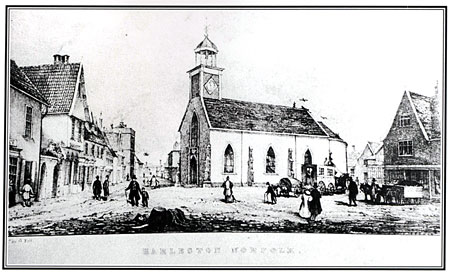
Harleston_Market place_1820
Harleston Market Square, Norfolk

Milligen – Norfolk

The Milligen family came from Glasgow, Scotland, to set up business and settle in the market town of Harleston, Norfolk, England, in the early 1700s. James Milligen was a Linen Draper, as was his son, John Milligen, born in Glasgow, 1694. We don’t know exactly where the family lived in Harleston, but James was buried 9 Oct 1940 at Redenhall near Harleston. The villages of Redenhall and Harleston are now a combined town covering an area of 13.73 km2. In 2001, the population was 4,058 in 1,841 households.

John Milligen married Elizabeth Smith, from Harleston, sometime before 1730. According to Faith Packard in Our Family History, ‘theirs was a happy marriage.’ They had two sons and four daughters none of whom carried on the draper’s business. ‘John retired to Shouldham near King’s Lynn where he bought himself a small estate and lived as a country gentleman.’ Shouldham covers an area of 16.04 km² and had a population of 608 in 246 households when I visited in 2001.

England_Harleston_map_a England_Shouldham_map_a
Harleston, Norfolk                                         Shouldham, Norfolk

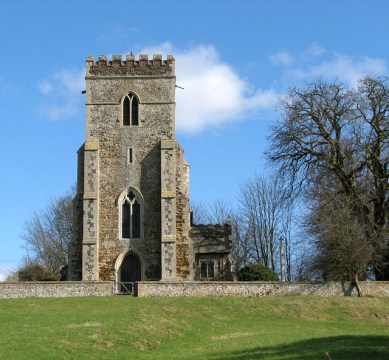
John and Elizabeth Milligen’s first born, John Milligen (b. 1730), moved to Plymouth, Devon, to become a Captain in the Royal Navy. Their youngest, Lydia Milligen (b.1740), married the Harleston cattle dealer, Robert Seppings, of Fakenham, Norfolk, in Fakenham, 1760. John Milligen, the father, died on 27 January 1762 aged 68 years at Shouldham, Norfolk, and was buried at the chancel of Shouldham Church in a family vault. The All Saints church is outside Shouldham in an elevated position overlooking the village. Built from a mixture of Carrstone and flint, the tower dates back to the late 13th/early 14th century.

Shouldham Church_Evelyn Simak All Saints church, Shouldham
Milligen_John_the chancel of Shouldham Church_family vault_a s Milligen_John_the chancel of Shouldham Church_family vault_drawing_a
In the aisle of the church is a brass plate with an inscription honouring the bodies of John Milligen and his unmarried daughter, Mary (1733-1827), lying beneath.

England_Norfolk_Shouldham_church_Milligen-Seppings_20010912_01a s
Faith Packard made a three cushion canvas work sedilia seat for Shouldham church to commemorate both John Milligen and his grandson Sir Robert Seppings. The sedilia seat was dedicated by the Bishop of Ely on his visit to Shouldham in 1973.

Milligen – Plymouth

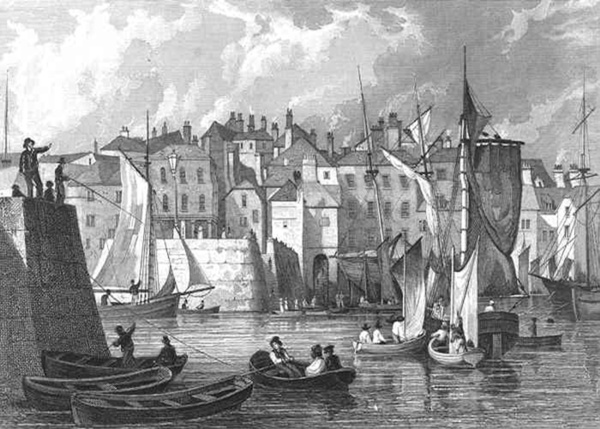
Plymouth_The Barbican, Pool & Co_steel engraving drawn by T. Allom, engraved by H. Wallis_1829

Capt John Milligen married Martha Phillips in 1759 in Plymouth, Devon. After his father died in 1762 they were well-off with money inherited from his father’s Will. They had no children of their own, but in 1780, at age 50, the captain adopted two of his sister Lydia’s children – Lydia Seppings (b. 1762) and John Milligen Seppings, age 10 (b. 1770) who was placed in the navy as a midshipman on Dunkirk, a store ship under the command of his uncle. When his father, Robert Seppings, died in 1781, age 47, Capt John Milligen adopted his older brother, Robert, age 14, and their six-year-old sister, Elizabeth. In 1782, he put Robert Seppings to work at the naval shipyards at Plymouth as an apprentice shipwright. He also adopted two orphaned daughters of his brother Thomas Milligen – Martha Phillips Milligen (b. 1766) and Charlotte (b. 1770) who would later marry her first cousin, Robert.
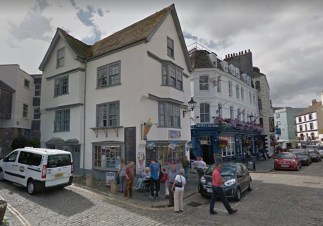
We don’t know where the Milligens and Seppings actually lived in Plymouth – many records were destroyed in WW2 – but it could have been at No 28 Gasken St.

Milligen_Plymouth_28 Gasking St_a Plymouth_Map of WW2 Bombings_1941
Gasken/Gasking St, Plymouth, Devon      WW2 Bombings, Plymouth, 1941

Capt John Milligen died in Plymouth in 1788. In his Will, he bequeathed ‘his house etc, to his wife Martha Phillips Milligen and his niece Charlotte Milligen’. One year later, John Milligen Seppings drew up his Will. At 18 years of age, he wished to leave his worldly estate to his Aunt Martha Milligen who was then residing at No. 28 Gasken Street, Plymouth. The house was probably destroyed during the Plymouth Blitz, 1941, as it no longer exists.

Photo & Illustration Credits

Harleston Market Square, Norfolk (1820)
http://www.ciaofamiglia.com/csaldous/aldouslinks.htm
Google Maps – Harleston, Norfolk
Google Maps – Shouldham, Norfolk
All Saints church, Shouldham, Norfolk, photograph by Evelyn Simak (2010)
Brass plate in All Saints church, Shouldham, Norlfolk, photo by Katherine Seppings (2001)
Handwritten inscription of brass plate by Faith Packhard
Cushion sedilia seat by Faith Packhard, All Saints church, Shouldham, Norlfolk, photograph by Katherine Seppings (2001)
The Barbican, Pool & Co, Plymouth
Steel engraving drawn by T. Allom, engraved by H. Wallis (1829)
Google Maps – 28 Gasking St., Plymouth
Map of WW2 Bombings, Plymouth, 1941 – Plymouth Library

Our Family History Faith Packard (1989)
Letter from Frank Raymond Seppings (2001)

http://info.visitwestnorfolk.com/Downham-Market-Shouldham/

Posted in Milligen | Tagged , , , , , , , , | 7 Comments

Seppings Ancestral Homes – England

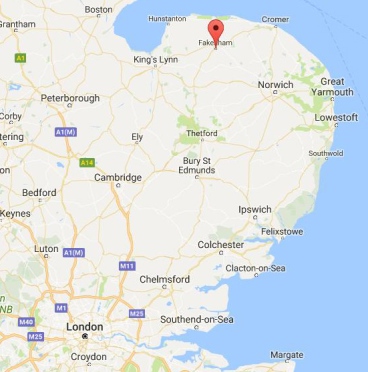
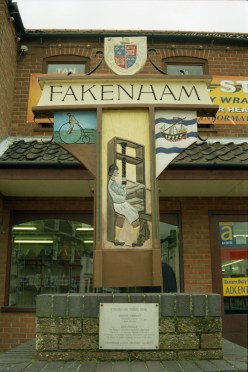
Fakenham map_02 England_Norfolk_Fakenham_sign_20010911 s

Where did our Seppings ancestors live?
The earliest record we have is of William Seppings, son of Thomas Seppings, born in Fakenham, Norfolk, 1638. William, an Oatmeal Maker, and his wife Dorothy, had five sons. The second son, Robert, our ancestor, was born in Fakenham in 1666.

Fakenham, on the river Wensum, is 40 km west of Norwich and 30 km north east of King’s Lynn. The Saxon name Fakenham means Hamlet (Ham) on a Fair (Fa) River (Ken). In 2001, when I visited the region to see where our Seppings ancestors had lived, the population was 7,357 in 3,292 households. In the 1086 Domesday Book, Fakenham only had 150 residents. The hamlet was given a Charter in 1250 and became a market town. On the other side of the river was the larger community of Hempton which hosted pilgrims at its abbey. In 1536 Henry VIII abolished the abbey and Fakenham became the dominant centre with market stalls set up around St. Peter & St. Paul’s parish church.

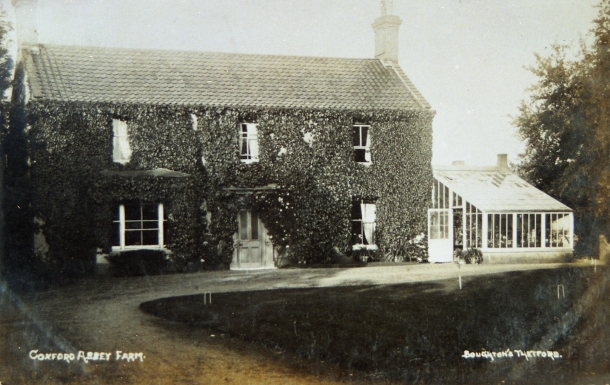
Seppings_Robert and Mary_Coxford Abbey Farm_Kings Lynn_Nth Norfolk_1712 s
Coxford Abbey Farm postcard

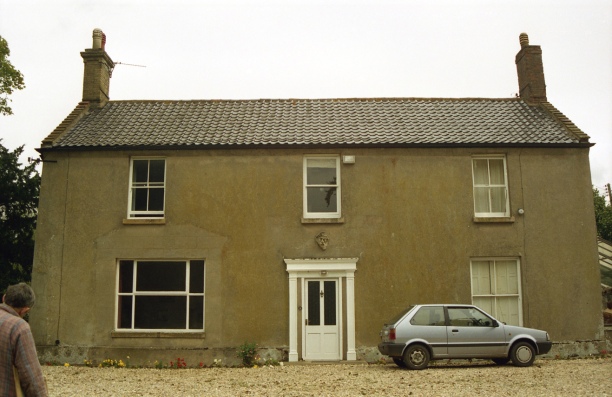
England_Norfolk_Coxford Abbey farm_Seppings_20010912_02a s
Coxford Abbey Farmhouse 2001

Robert Seppings, also an Oatmeal Maker, married Mary Hobbart in East Barsham, north of Fakenham, in 1706. They lived at Coxford Abbey Farm, Kings Lynn, North Norfolk, with their four children. ‘1712’ can be seen on the side of the building.

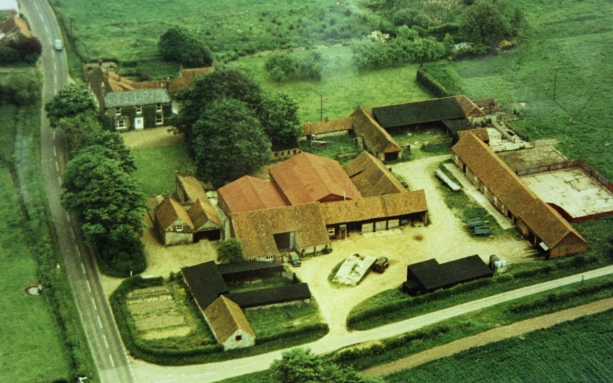
The remains of Coxford (Cokesford) Priory are in a field out the back, beyond an old brick wall to the south of the house. Founded around 1140, at St Mary’s church, East Rudham, the Augustinian Canons Regular transferred their community of priests to Coxford in 1216. The priory, dissolved by Henry VIII in 1536, was constructed of flint with stone dressings and is a grade II listed ruin.

In 2001, David and Ann Carter lived at Coxford Abbey Farmhouse. They allowed me to photograph the aerial image (1965) and the B/W postcard above.

Seppings_Robert and Mary_Coxford Abbey Farm_Kings Lynn_Nth Norfolk_1965_s
Coxford Abbey Farm 1965

England_Norfolk_Coxford Abbey farm_Seppings_20010912_04 s England_Norfolk_Coxford Abbey farm_Seppings_20010912_05a s
The remains of Coxford Priory are in a field beyond an old brick wall south of the house. Detail above front door of house.

Robert and Mary Seppings’ third son, Thomas (b. 1704), was our ancestor. Thomas, a Butcher, married Elizabeth Ballestone in 1726 at St Margarets church, Norwich, Norfolk. They had six children. Their third child, Robert, our ancestor, was born in Fakenham in 1734. Elizabeth died on the 4th of June 1752 and her husband Thomas died a week later on the 12th. Robert was almost 18 years of age and his youngest sibling was 11 years old. Elizabeth was buried on the 8th of June in the Churchyard at Fakenham, and Thomas was buried there on the 14th.

England_Norfolk_Fakenham_St Peters & Pauls church_20010911_01b s
St. Peter & St. Paul’s church, Fakenham.
Thomas and Elizabeth Seppings were buried in the Churchyard in 1752.
Robert and Lydia Seppings married there in 1760 and all their children were christened there. Robert was buried in the Churchyard in 1781.

Thomas and Elizabeth Seppings’ son, Robert, became a Cattle Dealer. He married Lydia Milligen, daughter of a Linen Draper in Harleston, at St Peter & St Paul’s church, Fakenham, in 1760. Robert and Lydia Seppings lived in a house in Holt Street, Fakenham, where their seven children were born. All were christened at St Peter & St Paul’s church. Their first two babies died soon after birth. Three girls and two boys survived. The two boys were Sir Robert Seppings (b. 1767) and his younger brother Lt John Milligen Seppings (b. 1770), our ancestor.

England_Norfolk_Fakenham_Holt St house_Seppings_20010911a s
Robert and Lydia Seppings’ home in Holt Street, Fakenham, where their children were born, including Sir Robert Seppings (b. 1767) and his younger brother, Lt John Milligen Seppings (b. 1770), our ancestor.

The home in Holt Street, Fakenham, is eight miles from Burnham Thorpe, where Admiral Horatio Nelson was born in 1758. (Captain George Vancouver was born nine months earlier in nearby King’s Lynn.) Robert Seppings’ cattle dealing business did not prosper, and from the age of twelve, his eldest son, Robert, carried letters to a neighbouring town by mule to contribute to the family.

The father, Robert Seppings, died in 1781, age 47, and was buried in the Churchyard at Fakenham. John Milligen Seppings and his sister, Lydia, had already been sent to live with their mother’s brother, Captain John Milligen, a retired Mariner in Plymouth, Devon. He and his wife, Martha, had no children, so in 1780 they adopted John, age 10, and placed him in the navy as a midshipman on Dunkirk, a store ship under the captain’s command. When John’s father died in 1781, his uncle adopted his older brother, Robert, age 14, and in 1782 put him to work at the naval shipyards at Plymouth as an apprentice shipwright under senior shipwright Mr Hensow. Captain John Milligen also adopted the boys’ six-year-old sister, Elizabeth Seppings, and two orphaned daughters of his brother, Thomas Milligen – Martha Phillips Milligen and Charlotte who would later marry her first cousin, Robert.

Plymouth_map_Engraved by John Cooke_1820
Map of Plymouth, Devon, 1820

Robert and Charlotte Seppings married in 1795 at the Parish church, Charles District, Plymouth. The navy board recognized Robert’s ingenuity and in 1804 moved him to Chatham as a master-shipwright. They lived at the Official house, Dockyard, Chatham, North Kent. When Robert Seppings was appointed to the office of surveyor of the navy in 1813 he worked in the South Wing of Somerset House, a large Neoclassical building on the south side of the Strand in London, overlooking the Thames, just east of Waterloo Bridge. Robert, Charlotte and their family of five surviving children lived at 6 Somerset Place, one of a row of houses used as dwellings for Admiralty officials on the western edge of Somerset House, until 1832 when he retired. The row of houses was demolished in 1856 for a Victorian wing. In 1989, I visited the North Wing of Somerset House where the Registrar office held all Birth, Marriage and Death certificates in England and Wales.
Robert and Charlotte moved to No 3 Mount Terrace, Taunton, Somerset, in 1832. Charlotte died there two years later and Sir Robert Seppings died there in 1840, age 72.

Seppings_Sir Robert_residence_No 3 Mount Terrace_Taunton_1989a s
Sir Robert and Lady Charlotte Seppings’ home –
No 3 Mount Terrace, Taunton, Somerset (1989)

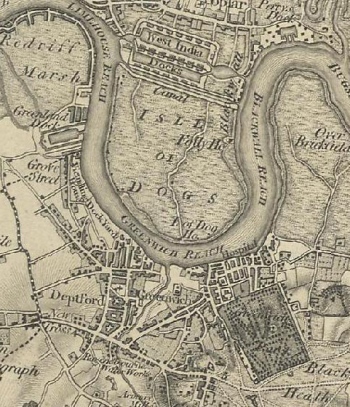
Lt. John Milligen Seppings married Ann Maria Marshall Lockyer at Charles the Martyr church, Plymouth, Devon, in 1804. They lived at Lime-kiln Lane, Greenwich, Kent, from 1804 to 1819 where nine of their eleven children were born. These children were all christened at St Alphages Church of England, Greenwich. Lt Edmund Henry Seppings, our ancestor, the first Seppings to live in Australia, was born at Lime-kiln Lane, Greenwich, in 1807. In the Baptism Register at St Alphages, John Milligen Seppings is listed as ‘Gentleman’. He was employed by the Royal Navy as Surveyor of Sloops and Comptroller of Revenue Cutters at Customs House, and Chief of Customs Service. Greenwich was a significant riverside town then but the rest of the borough was predominantly rural. Nearby Deptford and Woolwich had royal dockyards. Lime-kiln Lane is now named Greenwich South Street.

UK_Kent_Greenwich_St Alphages Church_1989a s Greenwich map_1805-Ordnance Survey First Series, Sheet 1 - GB Historical GIS_University of Portsmouth
Edmund Henry Seppings was christened at St Alphages Church of England, Greenwich, Kent, in 1808. Map of Greenwich 1805.

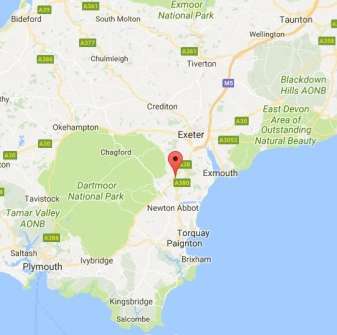
In 1819, when Lt. John Milligen Seppings retired from the Royal Navy, he and Ann moved to Budliegh, East Devon, before purchasing Culver House, a classic double-fronted 3-storey plus attic, six bedroom Georgian home at 31 New Exeter Street (formerly Culver Street), Chudleigh, Devon, where their youngest two children were born. According to the Chudliegh History Group, the name Culverhouse Meadow appears in a will of 1679. All large medieval manors had dovecotes and a culver was a keeper of pigeons, a bird often used in cuisine. A ‘For Sale’ advertisement appeared on 29 April 1819 in the Exeter Flying Post. Lt. John Milligen Seppings was the first recorded occupier using the Culver House name and started living there in 1821. The Chudleigh churchwarden accounts records the first time payment received from ‘Mr Seppings for his seat £1 17s 6d’ in that year.

Chudleigh_map_02
Chudleigh is a small town in Central Devon, between Newton Abbot and Exeter

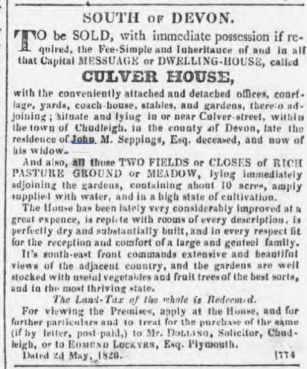
Lt. John Milligen Seppings lived at Culver House until his death, age 55, in March 1826. In May, his wife Ann put the house on the market and advertised their home in the Exeter Flying Post. Her uncle, Edmund Lockyer Esq., was involved in the handling of the sale. Culver House consisted of ‘conviently attached and detached offices, courtlage, yards, coach-house, stables, and gardens.’ There were also two fields of rich pasture adjoining the gardens – ten acres amply supplied with water ‘in a high state of cultivations.’

Seppings John Milligen - Sale Culver House by widow_a 1838_tithe_map1_culver_houseCulver House advertisement in the Exeter Flying Post 24 May 1826.
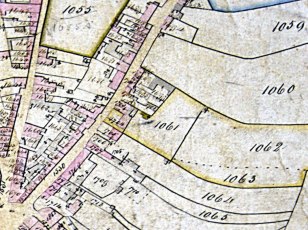
Extract from the 1838 Tithe map showing Culver House, Garden and Meadow plots outlined in yellow.

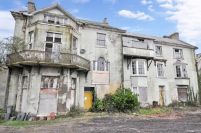
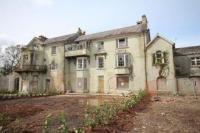
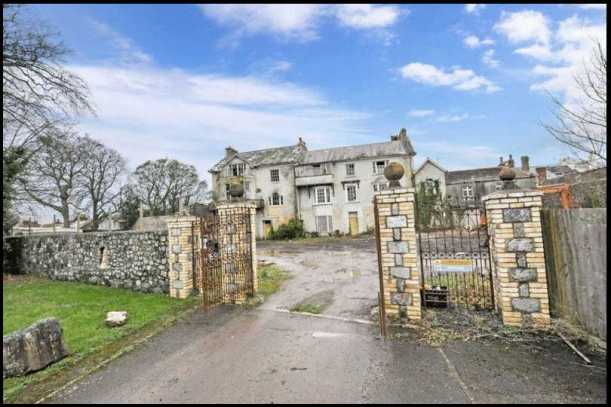
In 1843, Eliza Jane Bicknell Seppings, second daughter of the late Lt John Milligen Seppings, married Thomas Yarde Esq. in the Parish Church, Chudleigh, Newton Abbot, Devon. They had three boys and a girl. The Yarde family bought Culver House and occupied it from 1851 to 1909. Eliza died in 1854. The Chudliegh History Group note the Yarde family were recorded as ‘making improvements’. The house was probably doubled in size for the Yarde family in 1851/52 and extended again in the early 1880s. In the mid-1930s, the house was converted to nine flats and a vicarage was also located there during 1948-1954. By the 2000s all the flats were empty and in 2015 the building was becoming derelict. In 2016, the property was sold as three separate lots (Culver House, The School House & The Old Vicarage) and by September 2017 the three sections were being restored.
The high stone wall fronting the property is an important feature of the New Exeter Street streetscape. The wall and gate piers are Grade II listed (28 April 1987). The gateway is now the main entrance to the public Culver Gardens – previously the garden of Culver House – which included a Victorian rockery thought to have been a fernery and is now restored as such.
The National Buildings Register entry:
A section of wall containing dipping place for drinking water and gate piers to the
drive of Culver House. Local grey limestone rubble with dressed coping stones and
ashlar gate-piers. Tall stone wall with a round-headed niche for dipping place
(disused). Tall gate piers of square section with pyramidal caps. Larger inner gate
piers have deep chamfered inside corners, the chamfers have stops or moulded
corbels at their tops on which there are flat cap stones.

Culver House today in a derelict state
culver-house-230000-2 Culver House_Clive Pearce Property_05 Culver House 1
Culver House, Chudleigh, early 2000s

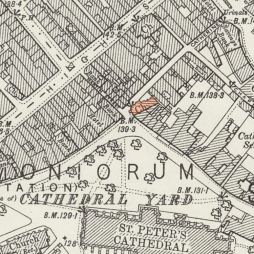
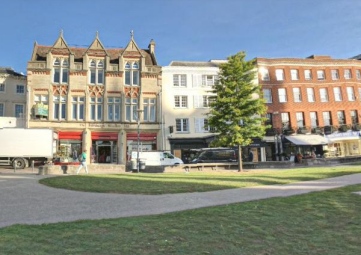
In the 1841 census, Ann Seppings, age 55, of ‘Independent means’, was living in Main Street, Chudleigh, Devon, with daughters Eliza (25), Augusta (20), Charlotte (15) and Edward (15). In 1851, Ann M Seppings, Lieutenants Widow (68) was ‘Head of House’, living with daughters Augusta M Seppings (30), Charlotte E Seppings (29) and servants Rhode Drinkwater, the cook (63), and Ann Manley, housemaid (23), at 22 Cathedral Yard in the Parish of St Martin, Exeter, Devon.
The parish of St Martins covered 0.7 hectares. In 1821 there were 329 residents in 62 houses which dropped to 207 in 1867. All the houses are now shops and offices. The Seppings residence is currently Michael Spiers Jewellers (2017).

Cathedral Yard map 22 Cathedral Yard_02
Ann M Seppings lived at 22 Cathedral Yard, Exeter, Devon in 1851 (house with blue shutters, now a jewellery shop)

Note: Lt John Milligen Seppings’ brother, Sir Robert Seppings, named his first son John Milligen Seppings (b. 1798) who had two children – Capt Edward James Seppings, born in 1826, Calcutta, India, who died, along with his wife and children, in 1857 at Cawnpore, Utter Pradesh, India, ending Sir Robert Seppings’ male line; and Charlotte Marianne Seppings, born 1828. In the 1841 census, could Charlotte (15) and Edward (15) have been those two children? Lt John Milligen Seppings and Ann M Seppings, had a daughter, Charlotte, but she was 19 years old in 1841. Charlotte E Seppings, age 29, was listed as living with Ann in 1851.

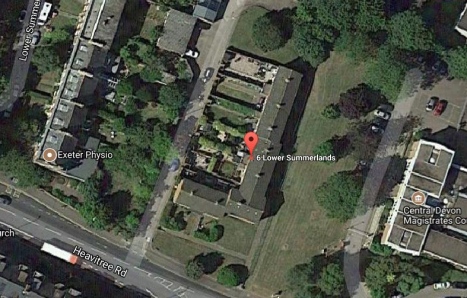
6 Lower Summerlands_02
Ann M Seppings died in 1859 at 6 Lower Summerlands, Exeter, Devon

Photo & Illustration Credits
Google Maps – Fakenham, Norfolk, England
‘Fakenham Sign’ photograph by Katherine Seppings (2001)
‘Coxford Abbey Farm postcard’ photo courtesy David and Ann Carter
‘Coxford Abbey Farm 2001’ photo by Katherine Seppings (2001)
‘Coxford Abbey Farm 1965’ photo courtesy David and Ann Carter
‘Coxford Abbey Farm old brick wall’ photo by Katherine Seppings (2001)
‘Detail above front door of house’ photo by Katherine Seppings (2001)
‘St. Peter & St. Paul’s church, Fakenham’ photo by Katherine Seppings (2001)
‘Seppings’ home in Holt Street, Fakenham’ photo by Katherine Seppings (2001)
‘Map of Plymouth, Devon’ Engraved by John Cooke (1820)
‘No 3 Mount Terrace, Taunton, Somerset’ photo by Katherine Seppings (1989)
‘St Alphages Church of England, Greenwich, Kent’ photo by Katherine Seppings (1989)
‘Map of Greenwich 1805’ Ordnance Survey First Series, Sheet 1 – GB Historical GIS / University of Portsmouth, History of Greenwich in Kent | Map and description, A Vision of Britain through Time.
Google Maps – Chudleigh, Devon, England
‘Culver House advertisement’ Exeter Flying Post 24 May 1826.
‘Extract from the 1838 Tithe map showing Culver House’ courtesy Chudleigh History Group
‘Culver House early 2000s’ Image 1 & 3 – courtesy Clive Pearce Property, Truro, Cornwall; image 2 & 4 – courtesy Woods Estate Agents & Auctioneers, Chudleigh.
‘Cathedral Yard map’ courtesy David Cornforth Exeter Memories
Google Maps – 22 Cathedral Yard, Exeter, Devon
Google Maps – 6 Lower Summerlands, Exeter, Devon

Research Resources

http://chudleighhistorygroup.uk/articles/notable_houses.html
http://www.chudleighhistorygroup.com/house-histories.
htmlhttp://www.exetermemories.co.uk/em/_churches/stmartins.php
http://maps.nls.uk/geo/explore/side-by-side/#zoom=18&lat=50.7231&lon=-3.5306&layers=117746211&right=BingHyb
http://www.britainexpress.com/counties/norfolk/churches/fakenham.htm
http://www.fakenhamparishchurch.org.uk/about-us/history/
http://www.cyber-heritage.co.uk/maps/mayflower.htm
http://www.ideal-homes.org.uk/greenwich/assets/historic-maps/central-greenwich/1805
http://www.visionofbritain.org.uk/place/167

The Gentleman’s Magazine p 422 (1843)

Posted in Seppings | Tagged , , , , , , , , , , , , , , , , | Leave a comment

Seppings Name

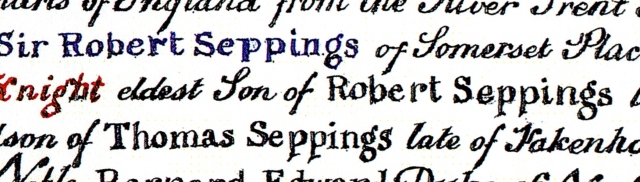
Seppings_Coat of Arms_crop

The name Seppings, originally from East Anglia, England, is thought to have derived from the nickname ‘Sevenpence’, someone not very tall.* One of the earliest listed is John Wolman Sevenpens (1403) in the Calendar of Norwich Freemen 1317-1603: Edward II to Elizabeth Inclusive under Henry IV. In 1524, the name was recorded in the form Sevenpennys and Sevynpenys. Through the centuries, Seppings has been spelt Seppens, Sippins (1540), Sypphinge, Sibbinge (1548), Sibbynge (1552), Seppins (1625), Sipins (1674), Sepens (1674), Sipping (1694), Sippons (1761), Sepings, Sippings and Sepping.

In Our Family History (1989), Faith Packard wrote, ‘It may have originated in north Suffolk as it appears in documents from the Halesworth – Blythburgh area in the 14th and 15th centuries. The parish registers of Fakenham in North Norfolk and the parishes round about have frequent mentions of the name from the beginning of the registers in the mid 16th century.’ In Suffolk, the Seppings name was referenced in 1540 when Nycholas Sevenpennys held lands and a family seat as Lord of the Manor.**

In Fakenham, Norfolk, where the Seppings name is deeply rooted, a fire damaged the town on 4 Aug, 1738 and, unfortunately, the early parish registers were lost and in them ancestral information on the Seppings. Other historic documents shedding light on the Seppings name may also have perished in the Norwich Central Library fire in 1994.

If you have the name Seppings in your family and you come across another Seppings you will be related. ‘The name never became widespread,’ wrote Faith Packard in 1989. ‘Though Seppings families are still met with in Norfolk the current London Telephone Directory lists only one Sepping and one Seppings.’ I met that one Sepping in a philosophy class he and I attended at the University of London, 1988.

There are various family history sites on the internet which estimate the numbers of Seppings on record. In 2017, ‘Ancestry’ claims to have 14,107 historical documents with the Seppings name, including 4,751 Births, Deaths and Marriages, 4,089 Census and Voter Lists, 160 Military Records and 112 Immigration Records. ‘My Heritage’ lists 3,141 people with the Seppings name and 917 with the name Sepping. 55% of Seppings lived in Great Britian, 18% in the United Kingdom, 18% in South Africa and 9% in Australia.

‘Research My Name’ states the Seppings name has been established in Europe for nearly 100 years, originally from Britian. They claim records dating back to 1131 suggest there was a contingency of Seppings’s in the county of Leicestershire, though I have not been able to verify this. Neither can I find a reference to their assertion, ‘It is written that a late 18th century Seppings could out drink a Rhino.’ Perhaps so. Many Seppings have been known to enjoy a drop. I agree with their conclusion of Seppings Traits. ‘The Seppings family are well known for their happy personalities.’ Although not all have had happy lives, just look at those smile lines. Listen to a Seppings laugh.

It is interesting to learn that all Seppings were law-abiding – at least there are no criminal records to be found. What the Seppings family name does carry is an extensive military history. Fifteen Seppings men, mostly from England, served in the First World War. Francis Edmund Henry Seppings of Wagga Wagga, NSW, was in the 1st Light Horse regiment at Gallipoli. Edmund Henry Seppings, the first Seppings to arrive in Australia was a Lieutenant with the Royal Navy, as was his father, John Milligen Seppings whose only brother, Sir Robert Seppings, naval architect, is a name well regarded in the history of shipbuilding and one of the most highly commemorated as a surveyor in the Royal Navy.

‘Seppings Blocks’ was a name given, in 1800, to the invention by Robert Seppings, then master shipwright assistant in the Plymouth dockyard, of a device which reduced the time and labour required for inspecting and effecting repairs to the lower hulls of ships in dry dock.

There were two ships named Seppings. The first Seppings, a barque of 393 tons, left Calcutta in 1839 and arrived in Port Jackson, 1840, via Port Phillip, carrying a cargo of sugar and 18 convicts from India, with four soldiers. The second, Sir Robert Seppings, a 628 ton ship, arrived at Van Diemen’s Land from Woolwich, England, in 1852, with 220 female convicts.

In 1826, Major Edmund Lockyer, first cousin of Sir Robert and John Milligen Seppings, hoisted the British flag at Albany and, on claiming Western Australia, an act which officially brought the whole of the Australian continent under the control of the British Crown, he named the freshwater lake there, Lake Seppings. There is a Seppings Island off the west of Vancouver Island, BC, Canada, and a Seppings Hill in Ewes, Scotland. Seppings Peak can be found on the island of Naungdaw, Rakhine, Myanmar. The Eskimo village, Kivalinagmiut, on the arctic coast between Point Hope and Cape Krusenstern, was named Seppings Cape by Cpt. F. W. Beechey, in 1827, while exploring the Bering Straight. Seppings Lagoon, Alaska, is on the shore of Chuckchi Sea, 22 miles NW of Kivalina, Kotzabue-Kobuk Low.

Pearson_Maya_The Pines_Kirby Cane_England_20011101068

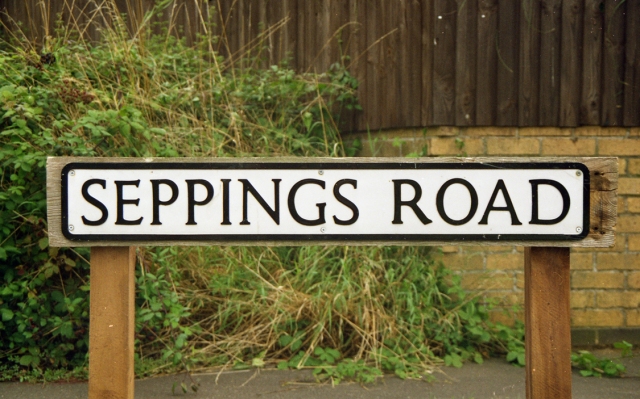
There is a Seppings Road in Norfolk, England, and in the Bangalore district of Karnataka, India, where Edmund Henry Seppings’ brother, Vice Admiral William Lawless Seppings, served in the military cantonment of the British Raj. In Albany there is a Seppings suburb and a Lake Seppings Drive. There is a Seppings Close in Wilburton, Ely, Cambridgeshire; a Seppings Way in Norwich, Norlfolk; and a Seppings Court in Flagstaff Hill, South Australia.

Various businesses have displayed the Seppings name. A Public House in Norfolk had the name Hogge and Seppings from 1861 into the 1920s. W. J. Seppings Butchers, makers of the famous Seppings sausage, was established in 1919 and still supplies meat to Suffolk and Norfolk from the original shop in Beccles. J. Seppings’ Boot Repairs in Yerong Creek, south of Wagga Wagga, NSW, was destroyed by fire in 1923. There was a Sepping’s Universe Cycle Store in Sydney, NSW, in the 1950s, which expanded to several stores and were run by three generations of Sepping. Alan J Sepping Pty Ltd was a Bicycle Accessories & Repairs shop in West Ryde, Sydney, until 2015.

The Seppings name is found as a fictional character, the butler ‘Seppings’, in the award-winning British comedy Jeeves and Wooster in Perfect Nonsense, and as Samuel Seppings, a ‘stolid-looking working-man’, called as a juror in Chapter 15 of The Red Thumb Mark by R. Austin Freeman. At Dripstone and Mumbil, NSW, in the 1930s, locals played tennis there for the Seppings Cup.

In the first generation of Australian Seppings there were four girls born. One died. The two boys, Edmund Henry Seppings and Francis Merewether Seppings carried on the Seppings name. Edmund Henry Seppings, my great-grandfather, had ten children. Three girls were born and it seems only one survived (though I don’t know when she died). My grandfather, Edgar Shelley Seppings, had five boys and of the three girls born, two survived. From the five boys, three daughters and ten sons were born. All survived. Those ten sons produced fifteen daughters and ten sons. One of those boys has had a son and the name Seppings lives on in a new generation. My grandfather’s brothers produced six sons between them, but of their five sons, one has died and only one boy is born to the current generation.
Francis Merewether Seppings had four sons and four daughters. His boys had five daughters and eight sons between them. The eight sons had five girls and six boys. For some reason, one of Francis Merewether Seppings’ sons, Francis Obediah, dropped the last ‘s’ on his Seppings name and so there is a branch, living in Sydney, with that spelling.

The names Lockyer, Milligen and Staines, from maternal lines, were repeatedly used as middle names for Seppings boys. As was Merewether – due to a family connection. Seppings has been used for a middle name in the Armstrong, Beloe, Buck, Clitherow, Codner, Colthurst, Cosens, Godfrey, Harper, Harrison, Hook, Howlett, King, Laws, Lock, Mitchell, Moore, Noye, Puttock, Tayton, Tirard, Wilson and Wright families, in England, usually with Robert as the first name. Seppings was also used as a first name in the Hook family. The Seppings name appears hyphenated for the famous artist, Henry Charles Seppings-Wright (1850-1937) and there is currently a Sooväli-Sepping as well as several Sepping in Estonia.

Of all the preferred names in Seppings families, John Milligen was used five times (2 were lieutenants), and in the Laws and Puttock families. Robert Seppings was repeated five times, straight, and once with Seymour added. William was used nine times; Thomas, five. Edmund, Edward, and Francis were used four times each. The most popular girl’s names were Charlotte and Mary. Some of the female names, such as Mary Seppings (nee Rapley), acquired the Seppings name through marriage. When my mother, Joan Katherine Webster (b. 1929), married my father, Edgar Shelley Seppings, she took on the same name as his sister, Joan Catherine Seppings, who died as a baby one month before my mother was born.

In the 1800’s, when a child died, the next born of the same sex was usually given the same name. Edmund Henry Seppings named his first son after himself (there was also another Edmund Henry in the Burma branch) and named his first daughter after Grace Darling, an English lighthouse keeper’s daughter who, in September 1838, became famous for seeing the shipwrecked Forfarshire off the Northumberland coast and helping to rescue nine survivors in a lifeboat. Grace Darling Seppings died in her first year but the name was given to the next daughter who survived. Edmund Henry Seppings’ son, Edmund Henry, named his first born daughter Grace Darling as well, but she, too, died in infancy.

My father, Edgar Shelley Seppings, had the same name as his father, the middle name was attributed to one of the most influential English Romantic poets. Shelley was radical in his poetry as well as in his political and social views. Sentiments not lost on the Seppings family or in the passing of time.

*Dictionary of English Surnames by P. H. Reaney
** ‘Research My Name’ website

Our Family History (1989), Faith Packard

‘Seppings Name’ image cropped from Seppings Coat of Arms grant doc. (1825)
‘Seppings Road – Norfolk, England’ photograph by Katherine Seppings (2001)

Posted in Seppings | Tagged , , , , , , , , , | 19 Comments